Edouard Cortes
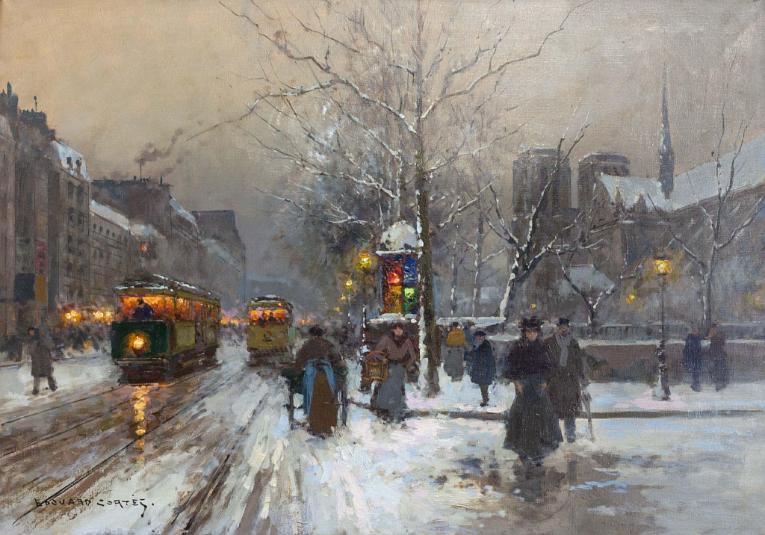
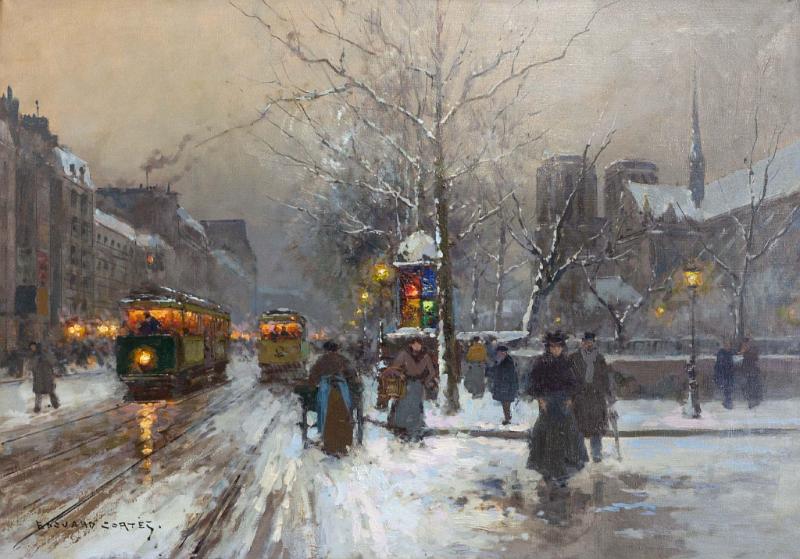
Quai de la Seine, Notre Dame en Hivre
Edouard Cortes
French, 1882 - 1969
Oil on Canvas
26 x 37 in. (66.0 x 94.0 cm)
Quai de la Seine, Notre Dame en Hiver, c. 1940s
Édouard Cortès (French, 1882–1969)
Oil on canvas, 26 x 37 in. (66 x 94 cm)
Signed lower left
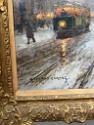
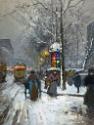
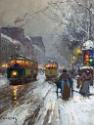
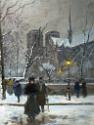
A hushed winter view along the Seine, with Notre Dame's spire rising through snow-laden trees into a pale, overcast sky. Electric trams glide past bundled figures navigating the freshly fallen snow, their dark silhouettes set against the soft, luminous glow of street lamps and tram lights — the interplay of chill and warmth that defines Cortès's finest winter Paris scenes. At 26 x 37 in., this is an unusually large and ambitious canvas within his output, the scale allowing for the kind of sweeping, atmospheric depth his smaller street scenes only hint at.
Why it matters: The spire seen rising above the cathedral here is the nineteenth-century spire designed by Eugène Viollet-le-Duc — the same spire destroyed in the catastrophic Notre Dame fire of April 2019 and only recently reconstructed to its original design, completed in 2024. A pre-fire depiction of Notre Dame carries added resonance for collectors today, capturing the cathedral exactly as it stood for over 150 years before that loss. Combined with the painting's scale and the artist's reputation as "Le Poète Parisien de la Peinture," this ranks among the more significant Cortès winter subjects to come to market.
Édouard Léon Cortès (1882–1969)
Born in Lagny-sur-Marne, just outside Paris, in 1882, Édouard Cortès was the son of Antonio Cortés, a painter at the Spanish royal court. He began formal training at the École des Beaux-Arts in Paris at seventeen and first exhibited at the Salon des Artistes Français in 1901, quickly earning recognition for his dramatic Paris street scenes at dusk. Wounded while serving at the front in the First World War, Cortès received the Croix de Guerre before being reassigned to a staff role that made use of his skill as a draftsman. Known as "Le Poète Parisien de la Peinture" — the Parisian Poet of Painting — he devoted his career almost entirely to the boulevards, markets, and monuments of Paris, rendering the city in every season and light, from sunlit boulevards to snow-covered quais lit by gas lamps. A member of the Société des Artistes Français and a regular exhibitor at the Salon des Indépendants, Cortès painted until his death in 1969. His work is held today in major private and public collections across Europe, North America, and Japan, and remains among the most sought-after of the Paris school painters on the market.
Édouard Cortès (French, 1882–1969)
Oil on canvas, 26 x 37 in. (66 x 94 cm)
Signed lower left
A hushed winter view along the Seine, with Notre Dame's spire rising through snow-laden trees into a pale, overcast sky. Electric trams glide past bundled figures navigating the freshly fallen snow, their dark silhouettes set against the soft, luminous glow of street lamps and tram lights — the interplay of chill and warmth that defines Cortès's finest winter Paris scenes. At 26 x 37 in., this is an unusually large and ambitious canvas within his output, the scale allowing for the kind of sweeping, atmospheric depth his smaller street scenes only hint at.
Why it matters: The spire seen rising above the cathedral here is the nineteenth-century spire designed by Eugène Viollet-le-Duc — the same spire destroyed in the catastrophic Notre Dame fire of April 2019 and only recently reconstructed to its original design, completed in 2024. A pre-fire depiction of Notre Dame carries added resonance for collectors today, capturing the cathedral exactly as it stood for over 150 years before that loss. Combined with the painting's scale and the artist's reputation as "Le Poète Parisien de la Peinture," this ranks among the more significant Cortès winter subjects to come to market.
Édouard Léon Cortès (1882–1969)
Born in Lagny-sur-Marne, just outside Paris, in 1882, Édouard Cortès was the son of Antonio Cortés, a painter at the Spanish royal court. He began formal training at the École des Beaux-Arts in Paris at seventeen and first exhibited at the Salon des Artistes Français in 1901, quickly earning recognition for his dramatic Paris street scenes at dusk. Wounded while serving at the front in the First World War, Cortès received the Croix de Guerre before being reassigned to a staff role that made use of his skill as a draftsman. Known as "Le Poète Parisien de la Peinture" — the Parisian Poet of Painting — he devoted his career almost entirely to the boulevards, markets, and monuments of Paris, rendering the city in every season and light, from sunlit boulevards to snow-covered quais lit by gas lamps. A member of the Société des Artistes Français and a regular exhibitor at the Salon des Indépendants, Cortès painted until his death in 1969. His work is held today in major private and public collections across Europe, North America, and Japan, and remains among the most sought-after of the Paris school painters on the market.
Categories