Oscar Edmund Berninghaus
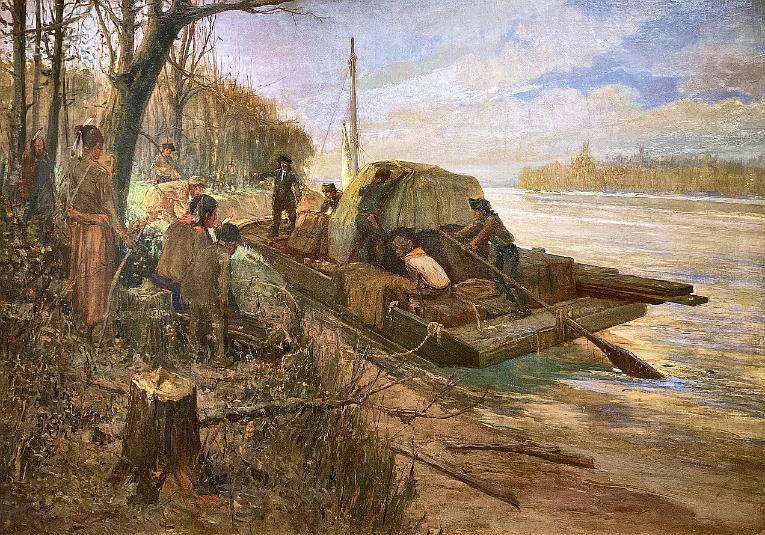
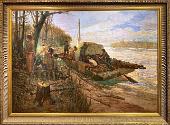
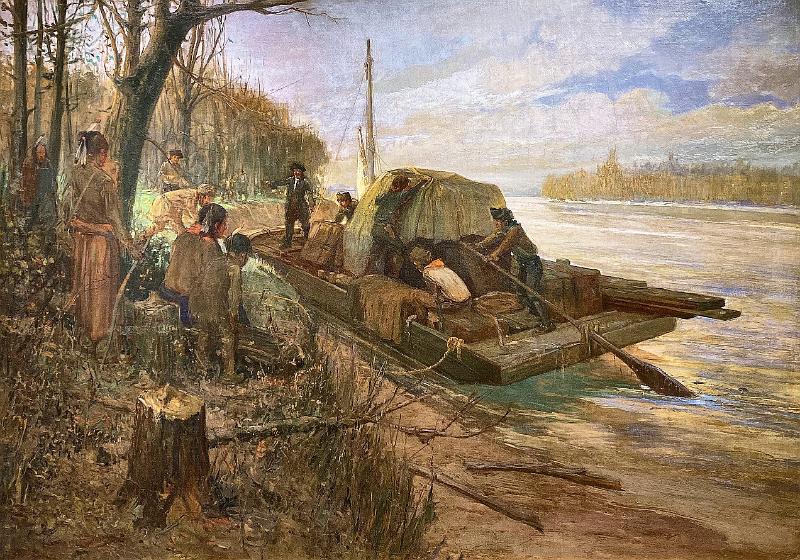
"The Discovery of St. Louis on the Banks of the Mississippi" (Pierre Laclede & Auguste Chouteau)
Oscar Edmund Berninghaus
American, 1874 - 1952
c. 1915
Oil on Canvas
46 x 56 in. (116.8 x 142.2 cm)
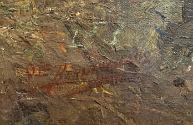
Oil on canvas. Signed lower left.
Laclede's party comes ashore on the west bank of the Mississippi: men unload a keelboat under a tarpaulin while a figure in a tricorn hat directs the work, and Native onlookers watch from the trees. In late 1763 Pierre Laclède chose the bluff below the mouth of the Missouri River for a fur-trading post, and in February 1764 his young stepson Auguste Chouteau led the men who began clearing the site that became St. Louis.
Berninghaus took up the founding of St. Louis in a 1914 series of historical scenes for Anheuser-Busch, part of the commercial work he did in St. Louis alongside his summers in Taos. The canvas dates from the year he helped found the Taos Society of Artists, and it shows the native son treating his city's origin on a full exhibition scale.
Oscar Edmund Berninghaus (1874–1952)
Oscar Edmund Berninghaus was born in St. Louis, Missouri, the son of a lithographer. At sixteen he left school to work in the printing trade, learning engraving and color lithography, and took night classes at the St. Louis School of Fine Arts at Washington University. In 1899 the Denver and Rio Grande Railroad commissioned him to sketch Colorado and New Mexico; he reached Taos, met Bert Phillips, and returned every summer for decades while working as an illustrator and painter in St. Louis. In 1915 he was a founding member of the Taos Society of Artists, and he served as its secretary longer than any other member. He was elected an Associate of the National Academy of Design in 1926 and moved permanently to Taos in 1925. His murals include works for the Missouri State Capitol, and his paintings are in the Saint Louis Art Museum, the Gilcrease Museum and the Philbrook Museum of Art. He died in Taos in 1952.
Categories
Oscar Edmund Berninghaus
c. 1920
Oil on Artist's Board