Alexander Calder
Les Oignons
Alexander Calder
American, 1898 - 1976
1976
Color Lithograph
20 3/8 x 28 1/4 in. (51.8 x 71.8 cm)
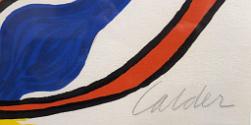
Signed Lower Right
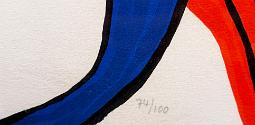
Edition 74/100
Alexander Calder (1898–1976) was an American artist best known for his innovation of the mobile—suspended sheet metal and wire assemblies activated in space by air currents. Born in Philadelphia to artist parents—his father a sculptor and his mother a painter—Calder moved to Paris in 1926 and created his Cirque Calder (1926–31), a unique body of work that captured the attention of the Parisian avant-garde.
Encyclopedia Britannica
Pace Gallery
Though Calder achieved international fame for his kinetic sculptures, he was equally accomplished as a printmaker. Featuring primary colors, geometric lines and spirals, and flattened biomorphic shapes, the imagery in Calder's lithographs is often reminiscent of his sculptural work. While many of Calder's prints may initially appear abstract, a closer look will reveal symbols of people, plants, and animals.
Artsy
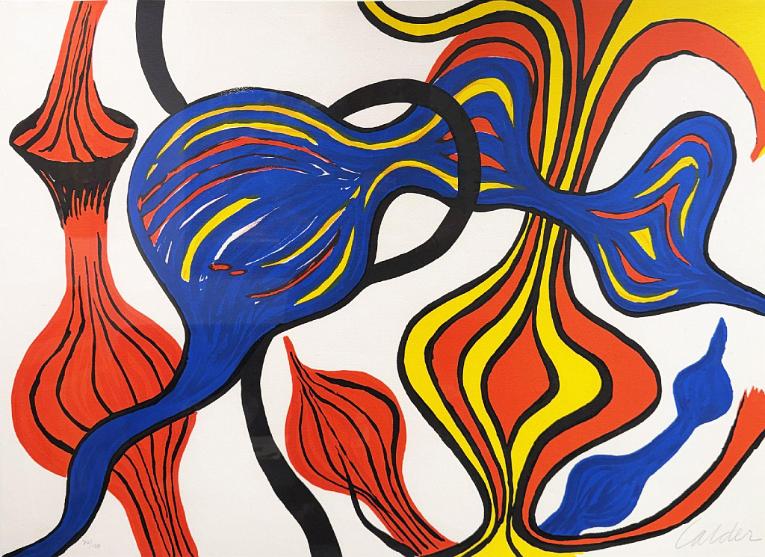
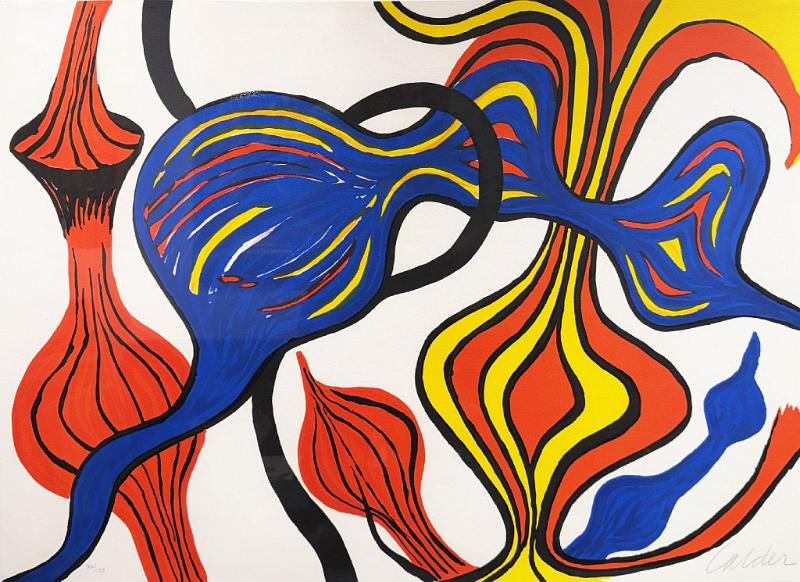
Les Oignons (The Onions) exemplifies this approach—its title whimsically suggests organic forms captured through Calder's abstract vocabulary. The vibrant composition employs the bold, saturated colors and dynamic linear patterns characteristic of his late-career printmaking, where scrolling curves and angular shapes dance across the composition with playful energy. The work demonstrates how Calder translated the spatial dynamism of his three-dimensional work into the two-dimensional language of lithography.
Calder died on November 11, 1976 in New York, making his late-career lithographs a testament to his enduring creative vitality and his ability to find endless formal invention across multiple media throughout his seven-decade career.
Edition 74/100
Alexander Calder (1898–1976) was an American artist best known for his innovation of the mobile—suspended sheet metal and wire assemblies activated in space by air currents. Born in Philadelphia to artist parents—his father a sculptor and his mother a painter—Calder moved to Paris in 1926 and created his Cirque Calder (1926–31), a unique body of work that captured the attention of the Parisian avant-garde.
Encyclopedia Britannica
Pace Gallery
Though Calder achieved international fame for his kinetic sculptures, he was equally accomplished as a printmaker. Featuring primary colors, geometric lines and spirals, and flattened biomorphic shapes, the imagery in Calder's lithographs is often reminiscent of his sculptural work. While many of Calder's prints may initially appear abstract, a closer look will reveal symbols of people, plants, and animals.
Artsy
Les Oignons (The Onions) exemplifies this approach—its title whimsically suggests organic forms captured through Calder's abstract vocabulary. The vibrant composition employs the bold, saturated colors and dynamic linear patterns characteristic of his late-career printmaking, where scrolling curves and angular shapes dance across the composition with playful energy. The work demonstrates how Calder translated the spatial dynamism of his three-dimensional work into the two-dimensional language of lithography.
Calder died on November 11, 1976 in New York, making his late-career lithographs a testament to his enduring creative vitality and his ability to find endless formal invention across multiple media throughout his seven-decade career.