George Caleb Bingham


Jolly Flat Boatmen
George Caleb Bingham
American, 1811 - 1879
1847
Aquatint Engraving
18 x 24 in. (45.7 x 61.0 cm)
Lettered in the plate "Painted by G. C. Bingham Esq." and "Engraved by T. Doney." Hand-colored. Published by the American Art-Union, New York, 1847.
On a flatboat drifting downriver, a young boatman dances on the deck while a fiddler and a crewman beating a tin pan keep time and the rest of the crew looks on. Below, the open hold is crowded with cargo, a ladder and a shirt hung to dry. The print reproduces Bingham's 1846 painting The Jolly Flatboatmen, now in the National Gallery of Art, Washington.
The American Art-Union bought the painting from Bingham and had it engraved as the print distributed to its members in 1847, when the organization counted nearly 10,000 subscribers across the country. The engraving carried Bingham's image of western river life into homes nationwide and did much to establish his reputation. Impressions are in the Metropolitan Museum of Art, the Detroit Institute of Arts, Crystal Bridges Museum of American Art and the Amon Carter Museum of American Art.
George Caleb Bingham (1811–1879)
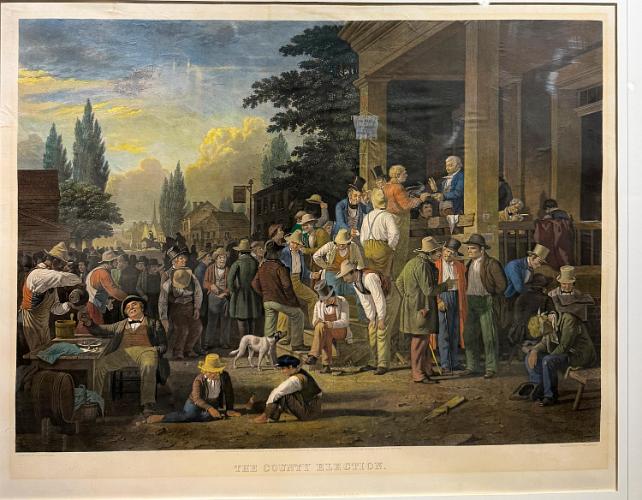
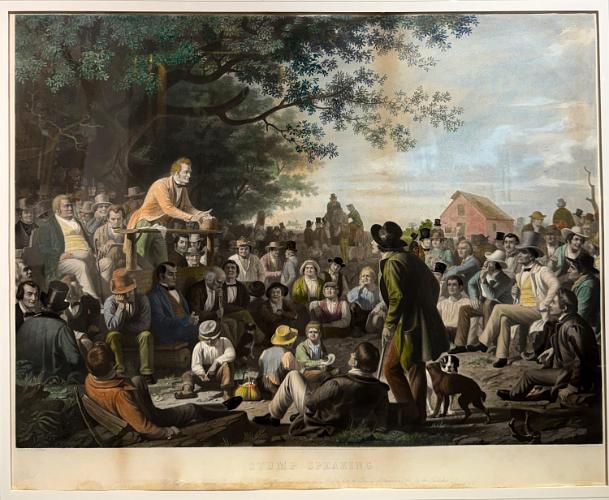
George Caleb Bingham was born in Augusta County, Virginia, and grew up in Franklin and Arrow Rock, Missouri. Largely self-taught, he began as a portrait painter, with brief study at the Pennsylvania Academy of the Fine Arts in 1838. Between about 1845 and 1860 he painted the river and political scenes that made him the defining painter of antebellum Missouri, among them Fur Traders Descending the Missouri, The County Election and Stump Speaking. He worked in Düsseldorf from 1856 to 1859. Bingham was also active in public life, serving in the Missouri legislature, as state treasurer during the Civil War and as adjutant general, and he became the first professor of art at the University of Missouri. He died in Kansas City in 1879.
Categories