William James Glackens
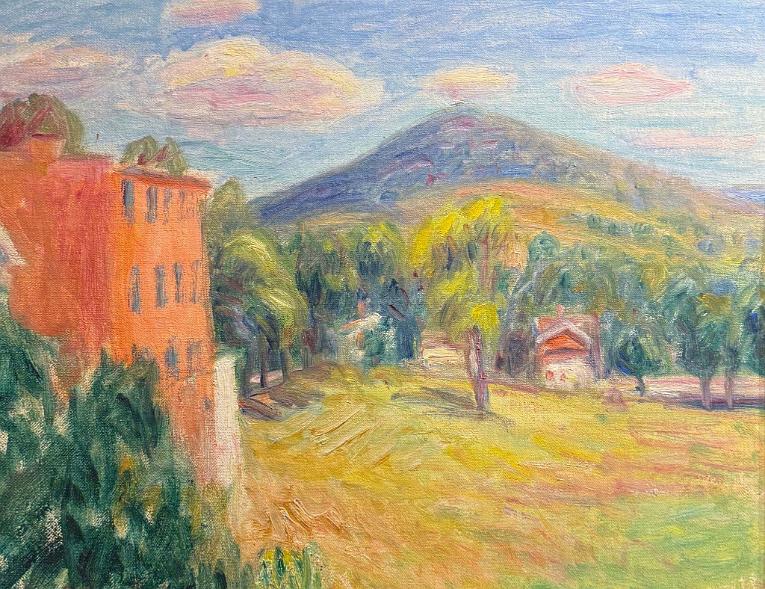
Southern French Landscape
William James Glackens
American, 1870 - 1938
Circa 1925
Oil on Board
11 3/4 x 14 in. (29.8 x 35.6 cm)
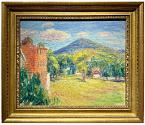
Framed: 15 3/4 x 18 1/2
Provenance: Estate of the Artist to Kraushaar Galleries, NYC
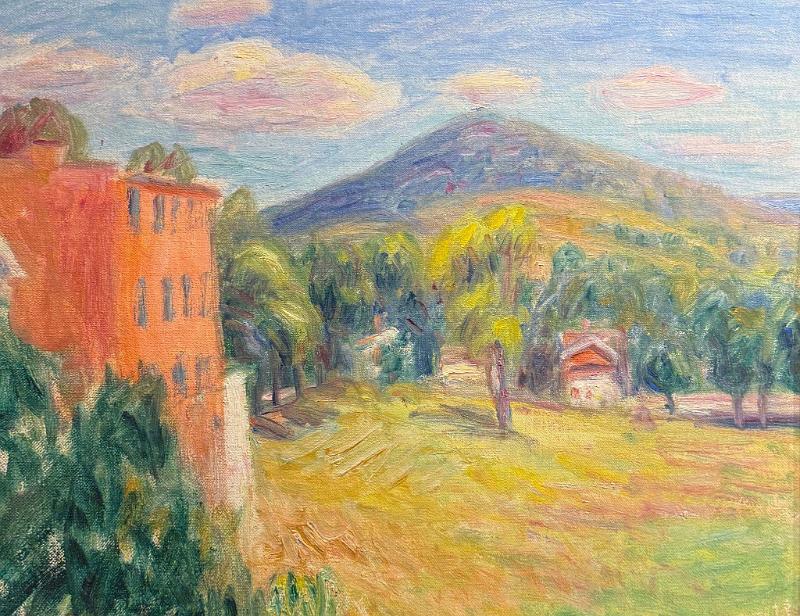
A sunlit hillside view of southern France, with a weathered stone tower and farm buildings set against rolling, mountain-backed terrain, painted in small, luminous strokes of green, gold, and lavender. The high-keyed palette and loose, vibrating brushwork reflect Glackens's deep attachment to the French countryside and his late-career affinity with Renoir's Impressionism.
Why it matters: By the mid-1920s Glackens had fully shed the dark urban realism of his Ashcan years for sun-drenched landscapes and still lifes painted during his frequent trips to France — a shift that defines the mature work most sought by collectors today. The provenance here is especially strong: the painting passed directly from the artist's estate to Kraushaar Galleries, the New York dealer that represented Glackens throughout his career and remained the steward of his estate's holdings, giving this board an unbroken, first-hand chain of ownership.
William James Glackens (1870–1938)
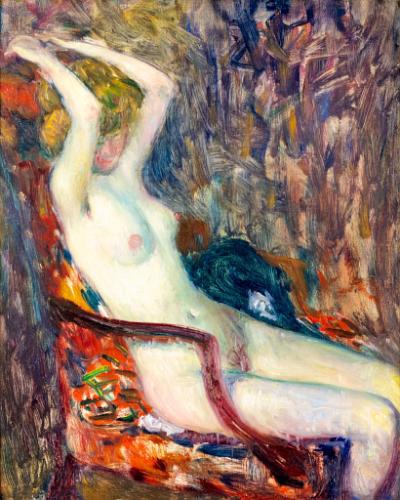
Born in Philadelphia in 1870, William Glackens began his career as an illustrator for the Philadelphia Record and later the New York Herald before turning to painting full time. In New York he became a founding member of "The Eight," the group of independent realist painters — including Robert Henri and John Sloan — later known as the Ashcan School, celebrated for their unvarnished depictions of urban life. After 1910, Glackens's style shifted away from the gritty street scenes of his early career toward a brighter, more decorative Impressionism shaped by his deep admiration for Renoir, producing the luminous nudes, still lifes, and landscapes — many painted during his travels in France — for which he is best known today. A childhood friend of the collector Albert C. Barnes, Glackens served as an influential advisor on Barnes's acquisitions, personally introducing him to the work of Matisse, Cézanne, Van Gogh, and Renoir during a 1912 trip to Europe — a role that helped shape one of the great collections of early modern art in America. Glackens died in Westport, Connecticut, in 1938. His work is held in major museum collections, including the Metropolitan Museum of Art, the Barnes Foundation, and the Brooklyn Museum.
Provenance: Estate of the Artist to Kraushaar Galleries, NYC
A sunlit hillside view of southern France, with a weathered stone tower and farm buildings set against rolling, mountain-backed terrain, painted in small, luminous strokes of green, gold, and lavender. The high-keyed palette and loose, vibrating brushwork reflect Glackens's deep attachment to the French countryside and his late-career affinity with Renoir's Impressionism.
Why it matters: By the mid-1920s Glackens had fully shed the dark urban realism of his Ashcan years for sun-drenched landscapes and still lifes painted during his frequent trips to France — a shift that defines the mature work most sought by collectors today. The provenance here is especially strong: the painting passed directly from the artist's estate to Kraushaar Galleries, the New York dealer that represented Glackens throughout his career and remained the steward of his estate's holdings, giving this board an unbroken, first-hand chain of ownership.
William James Glackens (1870–1938)
Born in Philadelphia in 1870, William Glackens began his career as an illustrator for the Philadelphia Record and later the New York Herald before turning to painting full time. In New York he became a founding member of "The Eight," the group of independent realist painters — including Robert Henri and John Sloan — later known as the Ashcan School, celebrated for their unvarnished depictions of urban life. After 1910, Glackens's style shifted away from the gritty street scenes of his early career toward a brighter, more decorative Impressionism shaped by his deep admiration for Renoir, producing the luminous nudes, still lifes, and landscapes — many painted during his travels in France — for which he is best known today. A childhood friend of the collector Albert C. Barnes, Glackens served as an influential advisor on Barnes's acquisitions, personally introducing him to the work of Matisse, Cézanne, Van Gogh, and Renoir during a 1912 trip to Europe — a role that helped shape one of the great collections of early modern art in America. Glackens died in Westport, Connecticut, in 1938. His work is held in major museum collections, including the Metropolitan Museum of Art, the Barnes Foundation, and the Brooklyn Museum.
Categories