
John Sloan
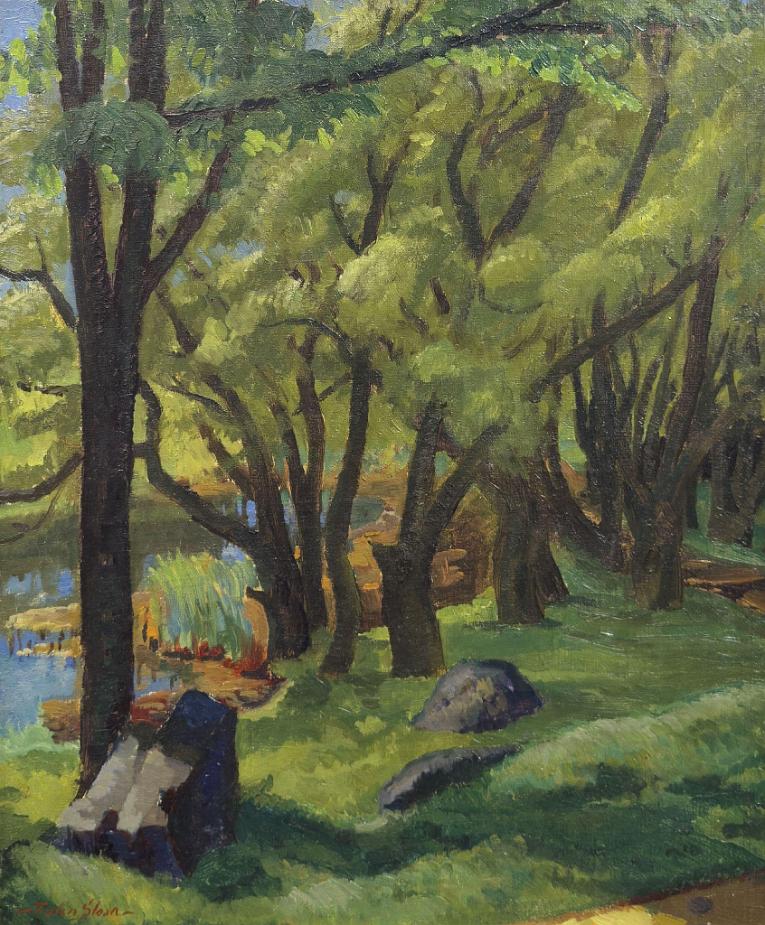
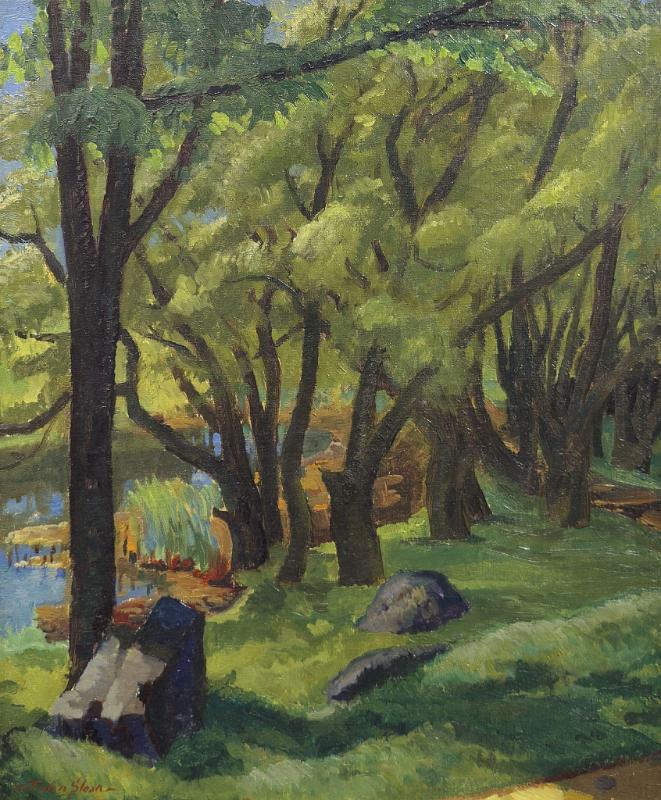
Willows
John Sloan
American, 1871 - 1951
1918
Oil on Canvas
24 x 20 in. (61.0 x 50.8 cm)
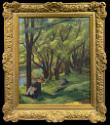
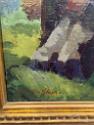
A sun-dappled woodland scene of willows and rocks, with a figure seated in the shade at lower left, painted in Sloan's loose, high-keyed outdoor manner. The canvas belongs to the series of landscapes Sloan produced during his summers in Gloucester, Massachusetts, where he worked from 1914 through 1918, developing a lighter, more Impressionist-influenced palette than the urban scenes for which he first made his reputation.
Why it matters: Sloan is best known as a founding member of the Ashcan School and a chronicler of gritty New York street life, but his Gloucester summers mark a pivotal and comparatively rare body of plein-air landscape work, painted at the close of his most experimental period with color theory under the influence of Hardesty Maratta. A landscape of this date and quality offers collectors a different, less commonly seen facet of Sloan's output than the urban scenes that dominate his market.
John Sloan (1871–1951)
Born in Lock Haven, Pennsylvania, in 1871, John Sloan began his career as a newspaper illustrator in Philadelphia before turning to painting under the encouragement of his friend and mentor Robert Henri. He moved to New York in 1904, settling in Greenwich Village, and became a founding member of "The Eight" — the group of independent realists, including Henri and William Glackens, that formed the core of the Ashcan School. Sloan's paintings and etchings of New York's streets, rooftops, and working-class neighborhoods established him as one of the era's most vital chroniclers of urban life, distinguished within the Ashcan circle by his strong political convictions and later involvement with socialist causes. From 1914 to 1918 he spent summers painting in Gloucester, Massachusetts, producing a lighter, color-driven body of landscape work. Sloan was also an influential teacher, notably at the Art Students League, shaping generations of American artists. He died in 1951, having left a lasting mark on twentieth-century American realism. His work is held in major museum collections, including the Metropolitan Museum of Art, the Whitney Museum of American Art, and the Delaware Art Museum.
Why it matters: Sloan is best known as a founding member of the Ashcan School and a chronicler of gritty New York street life, but his Gloucester summers mark a pivotal and comparatively rare body of plein-air landscape work, painted at the close of his most experimental period with color theory under the influence of Hardesty Maratta. A landscape of this date and quality offers collectors a different, less commonly seen facet of Sloan's output than the urban scenes that dominate his market.
John Sloan (1871–1951)
Born in Lock Haven, Pennsylvania, in 1871, John Sloan began his career as a newspaper illustrator in Philadelphia before turning to painting under the encouragement of his friend and mentor Robert Henri. He moved to New York in 1904, settling in Greenwich Village, and became a founding member of "The Eight" — the group of independent realists, including Henri and William Glackens, that formed the core of the Ashcan School. Sloan's paintings and etchings of New York's streets, rooftops, and working-class neighborhoods established him as one of the era's most vital chroniclers of urban life, distinguished within the Ashcan circle by his strong political convictions and later involvement with socialist causes. From 1914 to 1918 he spent summers painting in Gloucester, Massachusetts, producing a lighter, color-driven body of landscape work. Sloan was also an influential teacher, notably at the Art Students League, shaping generations of American artists. He died in 1951, having left a lasting mark on twentieth-century American realism. His work is held in major museum collections, including the Metropolitan Museum of Art, the Whitney Museum of American Art, and the Delaware Art Museum.
Categories
There are no works to discover for this record.