Wallace Herndon Smith

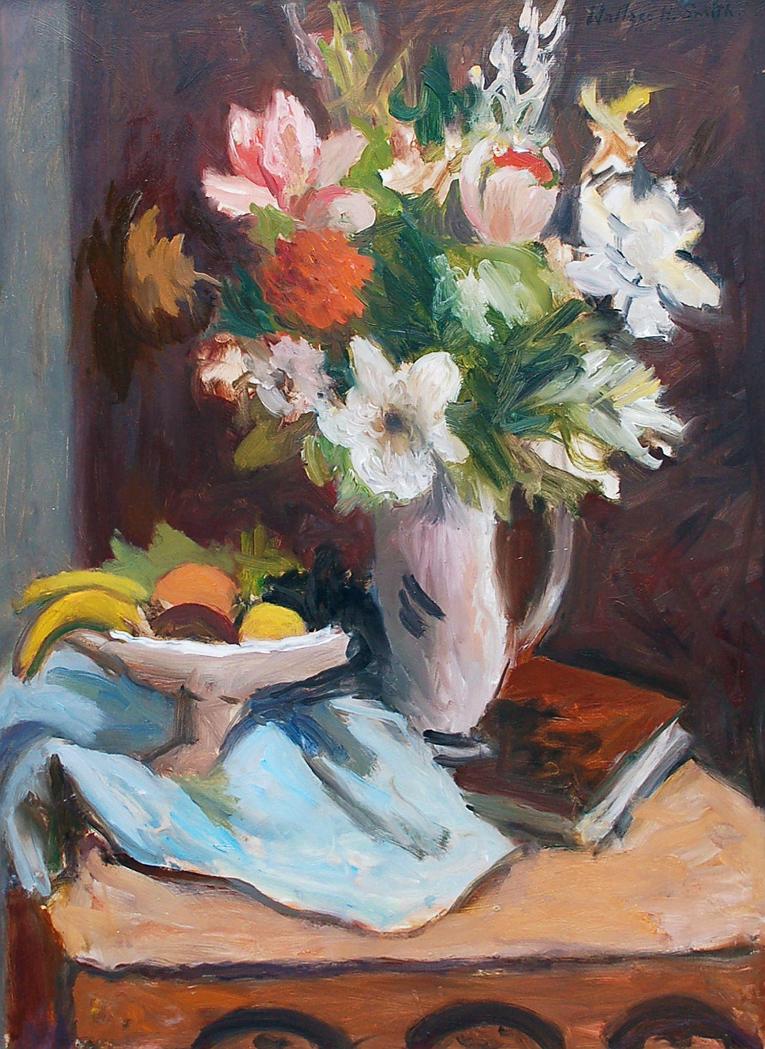
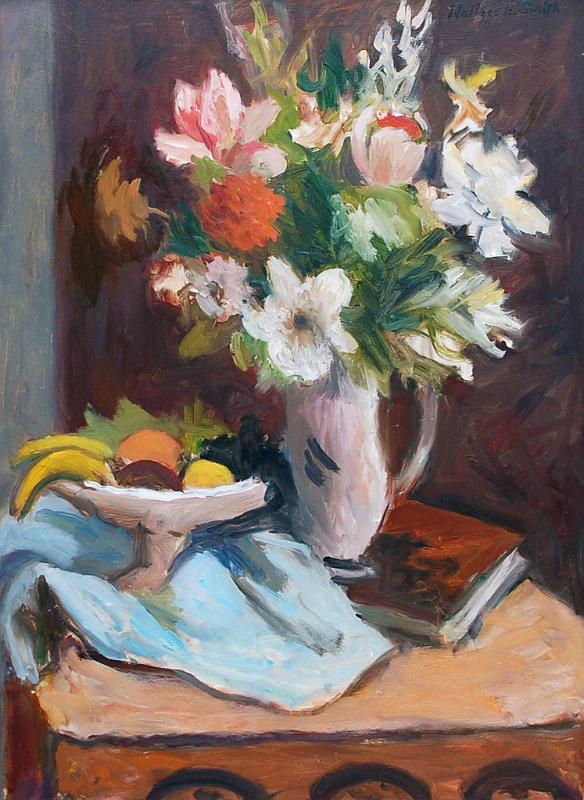
Floral Still Life with Bowl of Fruit

Floral Still Life with Bowl of Fruit

 American, 1901 - 1990
Oil on Canvas
28 x 20 in. (71.1 x 50.8 cm)
Framed: 32.5 x 38.75 inches

Wallace Smith was born in 1901 into affluence and spent much of his life defending his right to "artist" status. He painted mostly in his native St. Louis, but was never a regionalist as defined by art terminology. From his studies in France, he absorbed attitudes and skills associated with late nineteenth and early twentieth century French painters, but he applied his vision and his paint through a predominantly American, even midwestern, sensibility.

A traditional painter after the style of the Old Masters whom he revered, Smith found himself cast as an apologist for the classical style in a modernist era. It was not that he despised modern painting; it was a matter of knowing its limits. He once wrote that the proponents of "abstract" art claim that it "expresses the chaos of our times." He took exception. "I'm not sold on the fact that art must necessarily reflect chaos. Just because there's a puddle in the street, do I have to step in it?" By holding to traditional tenets in art, he often lost out in the scramble for public recognition and approval.

For fifty years he painted almost daily, and created over 500 paintings including still lives, land and city-scapes, scenes of boats and water, figure and portrait. One of his earliest works, "St. Louis Scene", was exhibited at the Art Institute of Chicago in 1932.

Artist Peggy Bacon wrote of her friend Wallace Smith: "His pictures themselves are like him for their lack of flourish. They are sensitive and economical, subtly subdued in color, restrained in their rejection of the stylized, and make no attempt at the dashing effect. The landscapes in particular appear to retreat and wait for an attentive observer to come along and notice their quiet virtue. But though they are generally very mild in mood, the canvases have structure and atmosphere and a very persuasive tonal quality; and once observed they shine like an open window."

There are no works to discover for this record.