
Crickets in November, New Albany, Ohio


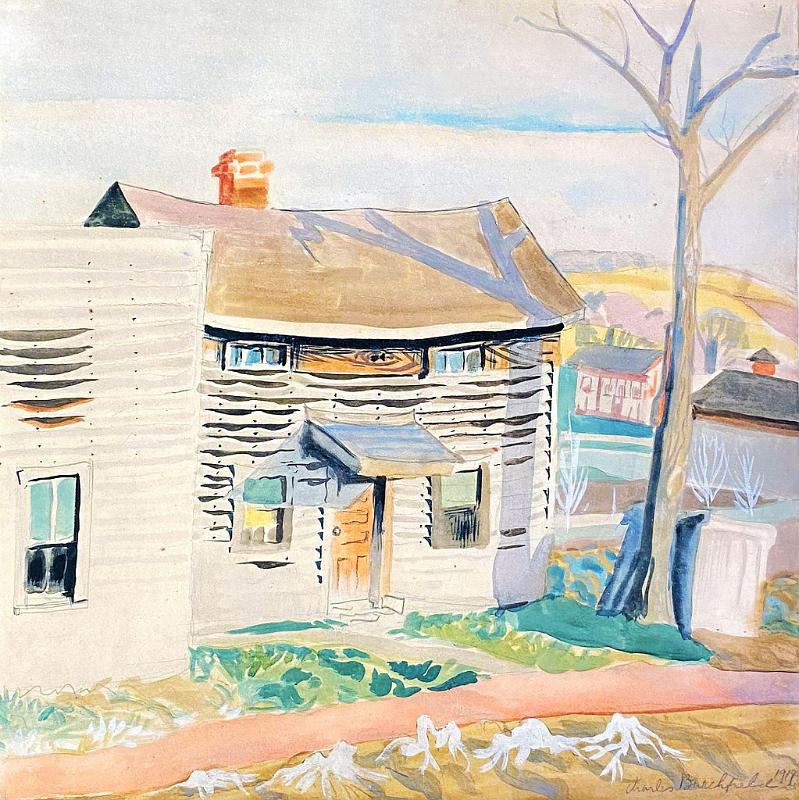
Crickets in November, New Albany, Ohio
Charles Burchfield
American, 1893 - 1967
1919
Watercolor and Gouache
17 1/2 x 17 1/2 in. (44.5 x 44.5 cm)
Signed and Dated Lower Right
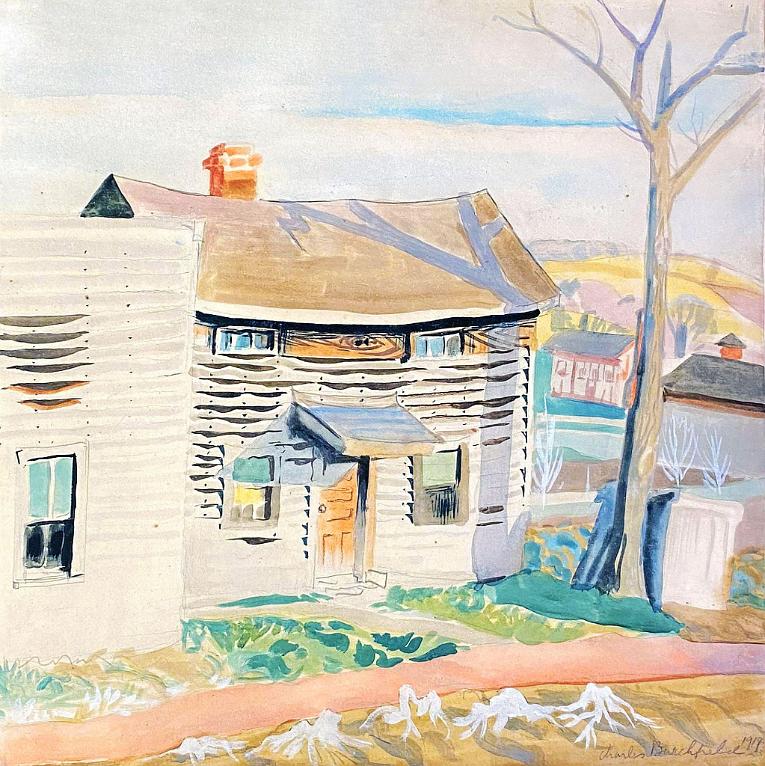
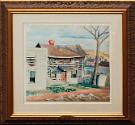
A weathered clapboard house and bare tree rendered in Burchfield's early, idiosyncratic watercolor style, in which ordinary rural buildings take on an almost animate presence. Painted in 1919 in New Albany, Ohio, a small village near Burchfield's boyhood home of Salem, the work captures the artist's lifelong fascination with the American small town — its textures, silences, and the psychological weight he found in humble architecture.
Why it Matters: This watercolor dates from the pivotal early phase of Burchfield's career, when he was translating memory, sound, and mood directly onto paper in a style that would later be described as visionary. The same New Albany house, identifiable by a distinctively knotted tree, reappears in a Burchfield lithograph now held by the Whitney Museum of American Art — confirming this as a real, recurring site in the artist's personal geography rather than an invented scene, and linking this sheet directly to a work in a major museum collection.
Charles Burchfield (1893–1967)
Charles Ephraim Burchfield was an American painter renowned for his emotionally charged watercolors of nature and small-town American life. Born in Ashtabula Harbor, Ohio, and raised in nearby Salem, he studied at the Cleveland School of Art under Henry Keller before beginning a career built almost entirely around watercolor — a medium he elevated to a scale and ambition usually reserved for oil painting. Critics have described Burchfield as part social critic, part naturalist, part transcendental visionary, sensitive to the sounds and psychological undercurrents of the landscapes he painted. His career moved through distinct phases: early works steeped in childhood memory and imagination; a middle period of unsparing Social Realism depicting the gritty streets and industrial towns of eastern Ohio and western New York; and a late return to the visionary, nature-suffused subjects of his youth. Burchfield's work is held in more than 109 museum collections and has been the subject of major exhibitions at the Metropolitan Museum of Art, the Whitney Museum of American Art, and the Museum of Modern Art. The Burchfield Penney Art Center in Buffalo, New York, houses the largest collection of his paintings, archives, and journals.
A weathered clapboard house and bare tree rendered in Burchfield's early, idiosyncratic watercolor style, in which ordinary rural buildings take on an almost animate presence. Painted in 1919 in New Albany, Ohio, a small village near Burchfield's boyhood home of Salem, the work captures the artist's lifelong fascination with the American small town — its textures, silences, and the psychological weight he found in humble architecture.
Why it Matters: This watercolor dates from the pivotal early phase of Burchfield's career, when he was translating memory, sound, and mood directly onto paper in a style that would later be described as visionary. The same New Albany house, identifiable by a distinctively knotted tree, reappears in a Burchfield lithograph now held by the Whitney Museum of American Art — confirming this as a real, recurring site in the artist's personal geography rather than an invented scene, and linking this sheet directly to a work in a major museum collection.
Charles Burchfield (1893–1967)
Charles Ephraim Burchfield was an American painter renowned for his emotionally charged watercolors of nature and small-town American life. Born in Ashtabula Harbor, Ohio, and raised in nearby Salem, he studied at the Cleveland School of Art under Henry Keller before beginning a career built almost entirely around watercolor — a medium he elevated to a scale and ambition usually reserved for oil painting. Critics have described Burchfield as part social critic, part naturalist, part transcendental visionary, sensitive to the sounds and psychological undercurrents of the landscapes he painted. His career moved through distinct phases: early works steeped in childhood memory and imagination; a middle period of unsparing Social Realism depicting the gritty streets and industrial towns of eastern Ohio and western New York; and a late return to the visionary, nature-suffused subjects of his youth. Burchfield's work is held in more than 109 museum collections and has been the subject of major exhibitions at the Metropolitan Museum of Art, the Whitney Museum of American Art, and the Museum of Modern Art. The Burchfield Penney Art Center in Buffalo, New York, houses the largest collection of his paintings, archives, and journals.
Categories
There are no works to discover for this record.