
The Boneheaded Cat
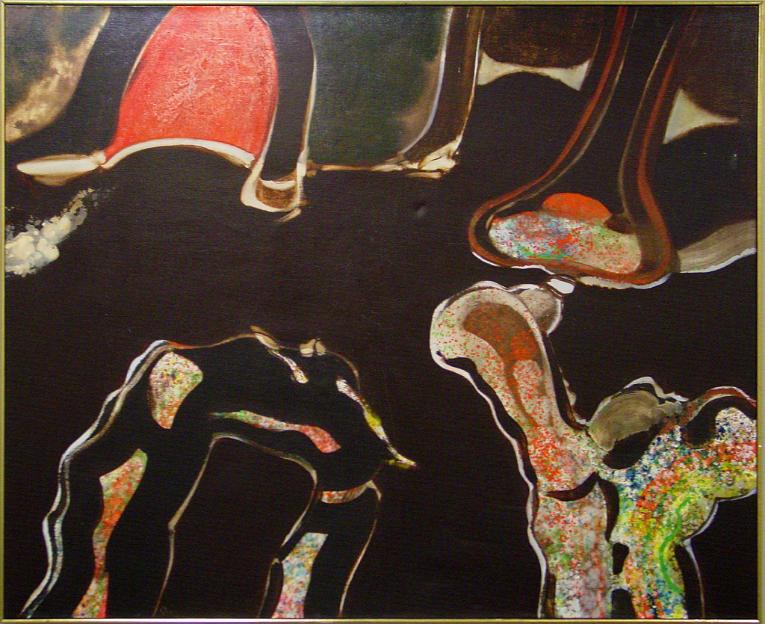
The Boneheaded Cat
William Quinn
American, 1929 - 2022
Oil on Canvas
18 x 58 in. (45.7 x 147.3 cm)
William Quinn (1929–2022) was born in St. Louis and earned a bachelor's degree in fine arts in 1953 from Washington University's School of Fine Arts. After two years in the U.S. Army, he earned his Master's in Fine Arts from the University of Illinois in 1957. Quinn joined the Washington University faculty in 1958 and was named professor emeritus in 1991, teaching at an institution where Abstract Expressionist masters Max Beckmann and Philip Guston had recently taught.
An artist who synthesized the elements of European modernists with the gestural style of Action Painting common to certain American Abstract Expressionists, Quinn moved to New York City after graduation, where he experienced the exhilarating artistic environment of the Abstract Expressionist movement led by Jackson Pollock, Willem de Kooning, and Robert Motherwell.
"The Boneheaded Cat" exemplifies Quinn's distinctive approach to color and form. The work presents a bold compositional statement rendered in dramatic blacks, oranges, and earth tones, with deliberate contrasts that demand the viewer's attention. Quinn's paintings are characterized by spacious and bold forms with surprising color combinations, many featuring linear structures that create spatial ambiguity—sometimes suggesting landscape or figurative elements while asserting the painting's two-dimensionality. Quinn works on one painting at a time, not in a series, as he abhors repeating himself, with each painting a new experience both for the painter and the viewer.
After retiring from teaching, Quinn moved to Europe, living in Bruges, Belgium, Vence, France, and eventually settling in Connecticut, where he continued to exhibit widely throughout his career.
There are no works to discover for this record.