
The Deer Hunters

The Deer Hunters
Laverne Nelson Black
American, 1887 - 1938
Oil on Artist Board
23 x 22 in. (58.4 x 55.9 cm)
Oil on Artist Board. Signed Lower Left. In Hand-Carved and Gilded Frame.
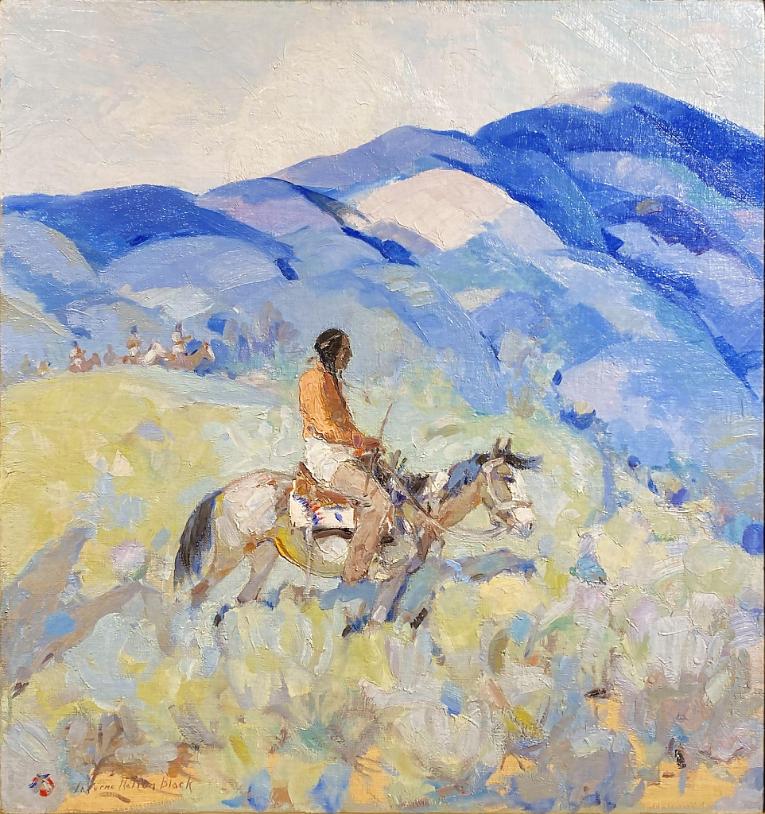
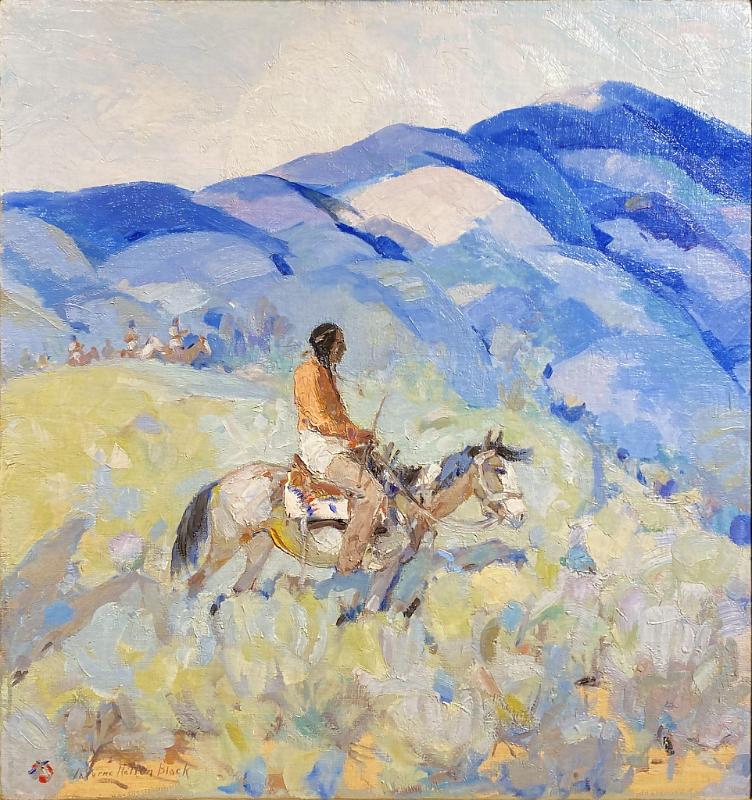
Painted circa 1920, "The Deer Hunters" captures LaVerne Nelson Black at a pivotal moment — the years before ill health compelled him to abandon the East entirely and commit himself fully to the Southwest he had been visiting and painting since his Chicago Academy days. A solitary Native American rider, mounted on a gray horse and moving through sage-covered high desert foothills, is set against the sweeping blue folds of a mountain range rendered in Black's characteristic broad, jittery brushwork. A procession of riders threads the distant ridge, suggesting the hunt as communal ritual rather than individual act.
This beautiful composition is spare and assured. Black resists the anecdotal in favor of atmosphere: the rider is present but unhurried, the mountains vast and indifferent, the pale desert scrub between them alive with broken color. The palette — cool cobalt and violet peaks against warm ochre and sage — reflects the influence of Black's Taos contemporaries, particularly Oscar Berninghaus and William Dunton of the Taos Society of Artists, who befriended Black and shaped his use of vibrant, realistic color alongside his energetic Impressionist brushwork. Born in Viola, Wisconsin, in the Kickapoo Valley — an area rich in Native American lore — Black's fascination with Indigenous subjects was lifelong. After studying at the Chicago Academy of Fine Arts, he worked in Chicago and New York as an illustrator, spending summers in the West sketching and painting before finally relocating his family to Taos around 1925, where he produced the strongest work of his career. His paintings entered the permanent collections of the Denver Art Museum, the Fred Jones Jr. Museum of Art, and the Smithsonian American Art Museum.
Painted circa 1920, "The Deer Hunters" captures LaVerne Nelson Black at a pivotal moment — the years before ill health compelled him to abandon the East entirely and commit himself fully to the Southwest he had been visiting and painting since his Chicago Academy days. A solitary Native American rider, mounted on a gray horse and moving through sage-covered high desert foothills, is set against the sweeping blue folds of a mountain range rendered in Black's characteristic broad, jittery brushwork. A procession of riders threads the distant ridge, suggesting the hunt as communal ritual rather than individual act.
This beautiful composition is spare and assured. Black resists the anecdotal in favor of atmosphere: the rider is present but unhurried, the mountains vast and indifferent, the pale desert scrub between them alive with broken color. The palette — cool cobalt and violet peaks against warm ochre and sage — reflects the influence of Black's Taos contemporaries, particularly Oscar Berninghaus and William Dunton of the Taos Society of Artists, who befriended Black and shaped his use of vibrant, realistic color alongside his energetic Impressionist brushwork. Born in Viola, Wisconsin, in the Kickapoo Valley — an area rich in Native American lore — Black's fascination with Indigenous subjects was lifelong. After studying at the Chicago Academy of Fine Arts, he worked in Chicago and New York as an illustrator, spending summers in the West sketching and painting before finally relocating his family to Taos around 1925, where he produced the strongest work of his career. His paintings entered the permanent collections of the Denver Art Museum, the Fred Jones Jr. Museum of Art, and the Smithsonian American Art Museum.
Categories
There are no works to discover for this record.