
Chemin de St. Pierre
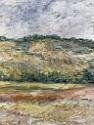
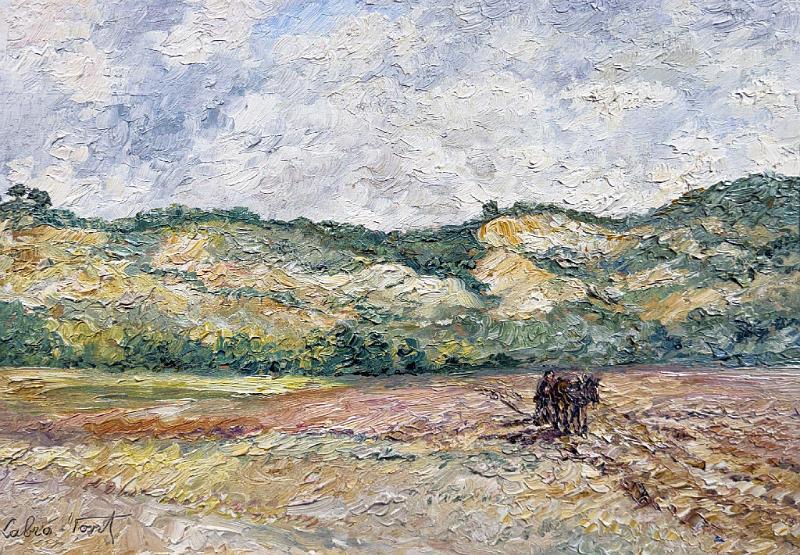
Chemin de St. Pierre
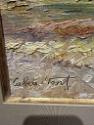
Louis Labro-Font
French, 1881 - 1952
1932
Oil on Board
15 x 21 3/4 in. (38.1 x 55.2 cm)
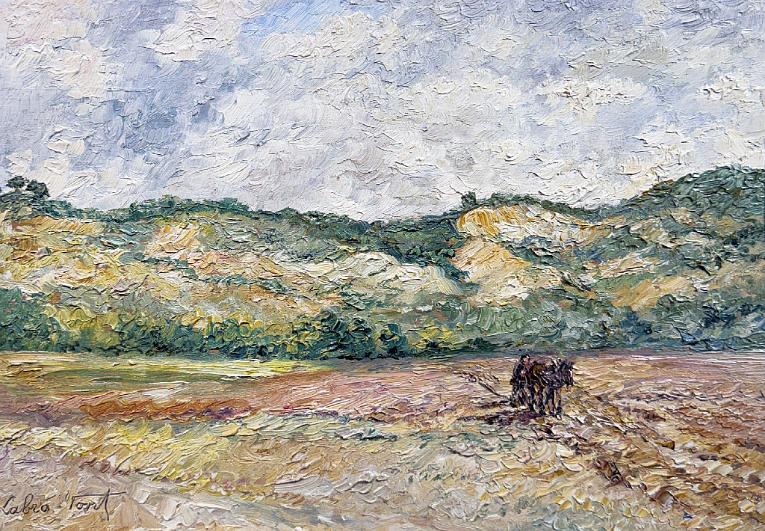
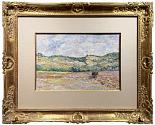
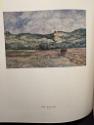
A sun-washed view of a plowed field beneath rolling, sculpted hills, with a team of horses and plow at work in the middle distance. Painted in thick, textured strokes of ochre and green, the work exemplifies Labro-Font's lifelong devotion to the landscape and rural life of Provence, rendered with the structural clarity of an artist trained as an architect.
Why it matters: Labro-Font deliberately avoided the commercial gallery circuit during his lifetime, repeatedly declining representation from the legendary dealer Ambroise Vollard — who at various points represented Cézanne, Bonnard, Vuillard, and Vlaminck — in favor of guarding his independence. As a result, his paintings remained almost entirely outside the market until his heirs began releasing them roughly forty years after his death in 1952, following a major centennial retrospective at the Château de Simiane in Valréas in 1981. This scarcity, combined with growing recognition of his work, makes any documented, catalogued example like this one a meaningful find for Post-Impressionist collectors.
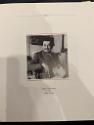
Louis Labro-Font (1881–1952)
Louis Labro-Font was a French Post-Impressionist painter whose work is defined by its quiet, disciplined devotion to the landscapes of Provence and the south of France. Trained and employed as an architect, he brought a rigorous sense of structure and geometric order to his painting, applying color theory — including Chevreul's principles of simultaneous contrast — with an almost instinctive precision. Labro-Font carried his sketchbooks, gouache, and watercolors with him on his architectural travels and building sites, often noting the exact time of day on the back of a canvas so he could return to the same light the following day. He eventually settled in the Drôme and later in Valréas, in the Vaucluse, where he found his mature voice amid haystacks, country fairs, and plane-tree-shaded squares — subjects he returned to with a progressively lighter palette as he aged. Fiercely independent, Labro-Font repeatedly turned down offers of representation from Ambroise Vollard, the dealer who championed Cézanne, Bonnard, Vuillard, Vlaminck, and Rouault, preferring instead to rely on friends such as Manzana Pissarro to place his work informally. He withheld the majority of his paintings from the market throughout his life; they were released by his heirs only decades after his 1952 death, following a landmark centennial retrospective at the Château de Simiane in Valréas in 1981, and are now recognized among the more significant rediscoveries of twentieth-century French landscape painting.
Why it matters: Labro-Font deliberately avoided the commercial gallery circuit during his lifetime, repeatedly declining representation from the legendary dealer Ambroise Vollard — who at various points represented Cézanne, Bonnard, Vuillard, and Vlaminck — in favor of guarding his independence. As a result, his paintings remained almost entirely outside the market until his heirs began releasing them roughly forty years after his death in 1952, following a major centennial retrospective at the Château de Simiane in Valréas in 1981. This scarcity, combined with growing recognition of his work, makes any documented, catalogued example like this one a meaningful find for Post-Impressionist collectors.
Louis Labro-Font (1881–1952)
Louis Labro-Font was a French Post-Impressionist painter whose work is defined by its quiet, disciplined devotion to the landscapes of Provence and the south of France. Trained and employed as an architect, he brought a rigorous sense of structure and geometric order to his painting, applying color theory — including Chevreul's principles of simultaneous contrast — with an almost instinctive precision. Labro-Font carried his sketchbooks, gouache, and watercolors with him on his architectural travels and building sites, often noting the exact time of day on the back of a canvas so he could return to the same light the following day. He eventually settled in the Drôme and later in Valréas, in the Vaucluse, where he found his mature voice amid haystacks, country fairs, and plane-tree-shaded squares — subjects he returned to with a progressively lighter palette as he aged. Fiercely independent, Labro-Font repeatedly turned down offers of representation from Ambroise Vollard, the dealer who championed Cézanne, Bonnard, Vuillard, Vlaminck, and Rouault, preferring instead to rely on friends such as Manzana Pissarro to place his work informally. He withheld the majority of his paintings from the market throughout his life; they were released by his heirs only decades after his 1952 death, following a landmark centennial retrospective at the Château de Simiane in Valréas in 1981, and are now recognized among the more significant rediscoveries of twentieth-century French landscape painting.
Categories
There are no works to discover for this record.