
Abraham Lincoln Presidential Document
Abraham Lincoln Presidential Document
The Battle of the Crater, fought on July 30, 1864, during the Siege of Petersburg, Virginia, stands as one of the most dramatic and tragic episodes of the American Civil War. Union forces, aiming to break through entrenched Confederate lines, devised a bold plan: to tunnel beneath enemy fortifications and ignite explosives, creating a gap for troops to exploit. The tunnel-dug by Pennsylvania coal miners-extended over 500 feet and was packed with 8,000 pounds of black powder. Its detonation produced a massive crater: 170 feet long, 60-80 feet wide, and 30 feet deep. The explosion initially stunned Confederate forces and killed approximately 250 soldiers, opening a crucial breach in their defenses.
However, the execution of the follow-up assault was catastrophically mismanaged. Union General Ambrose Burnside had originally selected a division of United States Colored Troops (USCT) to lead the charge. At the last minute, General Meade, with Grant's approval, replaced them with white troops-fearing political backlash if the Black soldiers suffered heavy losses.
The unit selected to lead the attack was commanded by Brigadier General James H. Ledlie. His troops were neither trained nor briefed on the plan. Ledlie himself remained far behind the lines, reportedly drinking in a shelter. Without clear orders, the soldiers entered the crater instead of moving around it. The steep walls trapped them, and Confederate forces rallied to fire down on the disoriented Union soldiers
.
The result was a devastating Union defeat:
- Union casualties: approximately 3,800
- Confederate casualties: approximately 1,500
General Ledlie was singled out for his lack of leadership. A court of inquiry condemned his behavior, and he was quietly relieved of duty, resigning in January 1865. The Battle of the Crater has since become a case study in both tactical innovation and leadership failure. It also remains a painful reminder of missed opportunities and the overlooked role of Black soldiers who had been prepared and ready for the task.
Legacy
The Battle of the Crater has endured as a cautionary tale in military history-an example of how innovation, if poorly executed, can lead to catastrophe. It is studied in military academies and historical literature for its lessons in planning, leadership, racial politics, and battlefield execution.
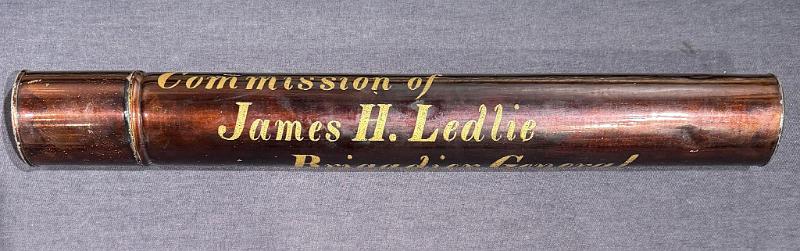
The Commission of Brigadier General James H. Ledlie
This report presents a comprehensive examination of the military commission of Brigadier General James H. Ledlie, signed by President Abraham Lincoln and Secretary of War Edwin M. Stanton in July 1864. The document is preserved in its original lacquered tube and velvet-lined case, accompanied by a British customs declaration from 1914 signed by Garter King of Arms H. Farnham Burke. The commission's journey from the American Civil War to England and back to St. Louis, Missouri, reveals a layered narrative of preservation, lineage, and historical significance.
James H. Ledlie: Biography and Military Service
Born in Utica, New York, in 1832, James Hewett Ledlie was a civil engineer who joined the Union Army during the Civil War. He rose quickly through the ranks, ultimately being appointed Brigadier General. Ledlie's Civil War career is most noted for his controversial command at the Battle of the Crater during the Siege of Petersburg. Accused of poor leadership, he failed to lead his men into battle, choosing instead to remain in the rear. Despite this, President Lincoln's signed commission attests to the level of trust placed in him at the time.
Ledlie resigned in January 1865 and returned to work in civil engineering, contributing to western railroad development. He died in Staten Island in 1882 and was buried in Forest Hill Cemetery in Utica, New York.
The Commission and Original Tube
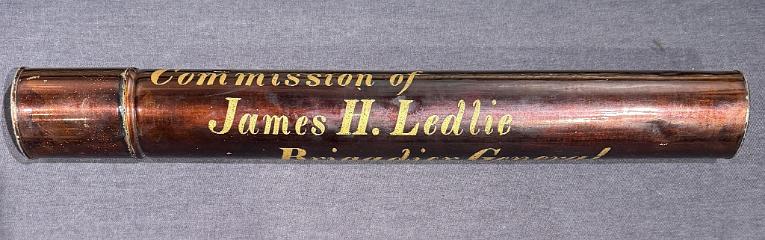
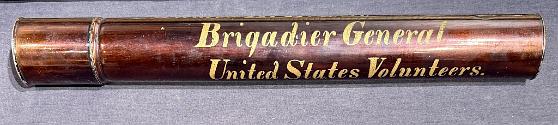
The commission is executed on vellum and features engraved patriotic illustrations, the original blue War Department seal, and signatures of President Abraham Lincoln and Secretary of War Edwin M. Stanton. It is housed in a cylindrical lacquered presentation tube, hand-lettered in gold: 'Commission of James H. Ledlie/ Brigadier General / United States Volunteers.' The accompanying case is lined in royal purple velvet and decorated externally with British royal insignia-suggesting official custody or archival preservation abroad.
Transatlantic Provenance and Charles Hees Ledlie
The 1914 customs declaration found with the case was addressed to 'C. H. Ledlie, Esq.' in St. Louis, describing the contents as 'illuminated writing on vellum' and signed by H. Farnham Burke, Garter Principal King of Arms of the College of Arms in London. This document provides critical evidence of the commission's temporary preservation in the United Kingdom-likely for heraldic or genealogical purposes.
Charles Hees Ledlie (1861-1940), the recipient, was the great-nephew of General James H. Ledlie and served as a family custodian of records and personal documents. Given the increasing tensions in Europe in early 1914, it is plausible that Charles Hees Ledlie requested the return of this prized family heirloom in anticipation of possible disruption due to the outbreak of World War I.
Charles H. Ledlie was deeply involved in St. Louis' industrial and utility infrastructure. His correspondence, archived in the Missouri Historical Society Library, reveals business dealings with:
- Union Electric and Power Company (St. Louis)
- Citizens Electric Lighting and Power Company (St. Louis)
- Saint Louis Street Car Company
- American Car Company (Granite City, Illinois)
- Kinloch Telephone Company (St. Louis)
- Imperial Electric Light, Heat and Power Company (St. Louis)
- Hannibal Water Works (Hannibal, Missouri)
These connections place Charles H. Ledlie at the center of Missouri's industrial expansion in the late 19th and early 20th centuries, lending further weight to the commission's documented journey and its return to a highly prominent figure within the Ledlie family.
Historical Significance and Rarity
Civil War commissions signed by Abraham Lincoln are rare. Most were discarded, lost, or remain isolated f rom their historical context. Fewer still retain their original presentation containers. Even fewer are accompanied by third-party documentation confirming chain of custody.
This artifact is exceptionally complete:
- Original signedand sealed vellum cc:fmmission
- Custom-lacquered and hand-lettered presentation tube
- Velvet-lined protective case adorned with British royal symbols
- 1914 British customs declaration signed by the Garter King of Arms
Its documented provenance, Lincoln's original signature, and its international journey from wartime Washington to royal British archives and back to St. Louis through one of Missouri's most industrially engaged families, makes this an unparalleled piece of Civil War material culture.
The Royal Lacquered Case: Craftsmanship, Provenance, and Heraldic Significance
The presentation case accompanying the 1864 commission of Brigadier General James H. Ledlie is a custom-made, lacquered and velvet-lined wooden container adorned with British royal insignia. Its construction, symbols, and archival documentation firmly place it within the sphere of official British heraldic preservation, most likely under the authority of the College of Arms, London, in 1914.
Overview
This case, finished in a deep burgundy lacquer and lined with royal purple velvet, was designed to contain the vellum commission signed by President Abraham Lincoln and Secretary of War Edwin M. Stanton. The exterior features finely gilt decoration, including crowned emblems and a prominent cipher reading “GR V,” denoting King George V of the United Kingdom (reigned 1910–1936). Such craftsmanship indicates that the case was produced for official or ceremonial use, not as a private commission.
Manufacture and Institutional Context
No manufacturer’s mark appears on the case; however, several key details point toward its creation under the auspices of the British royal heraldic authority. The 1914 customs declaration enclosed within the case bears the signature of H. Farnham Burke, Garter Principal King of Arms—the highest-ranking officer of arms at the College of Arms in London. Burke’s personal endorsement, combined with the presence of the royal cipher and crown emblems, strongly suggests that this case was made either by or for the College of Arms to safeguard and repatriate the Ledlie commission to its American custodians in St. Louis.
The College of Arms frequently commissioned presentation and archival cases from select London workshops that produced high-quality lacquered wood and velvet-lined boxes for royal documents and heraldic instruments. While the specific workshop remains unidentified, candidates include established suppliers to the royal household such as W. Day Son or Henry T. Wood, both known for producing document cases and presentation cylinders in the early 20th century.
Symbolism of the Royal Cipher and Crown
The gilt monogram 'GR V' stands for 'Georgius Rex V,' or 'King George V,' the Latin form of the monarch’s name and title. This cipher was used officially by the British government, the royal household, and affiliated institutions from 1910 to 1936. Its presence on the case indicates royal sanction and association with the reigning monarch’s authority.
Surrounding the cipher are multiple impressions of the St. Edward’s Crown, one of the most enduring emblems of the British monarchy. The crown’s inclusion signifies official royal custody, reinforcing that the case was not decorative but functional within a governmental or heraldic context. In this instance, it almost certainly denoted official archival custody for a foreign historical document of significance.
Archival Role and Historical Purpose
By 1914, as Europe approached the outbreak of World War I, Charles Hees Ledlie, son of General James H. Ledlie and resident of St. Louis—likely arranged for the retrieval of his family’s prized heirloom from England. The College of Arms, under H. Farnham Burke’s authority, served as the intermediary for repatriating the commission. It is plausible that the lacquered case was produced specifically to protect and transport the vellum commission, ensuring its safe passage from British archives back to Missouri.
The inclusion of the royal cipher and the Garter King of Arms’ signature on the customs declaration creates a chain of official custody that is virtually unparalleled in Civil War artifact provenance. Few, if any, Lincoln-signed commissions are known to have been handled through royal British archival systems.
Summary and Significance
The lacquered case for Brigadier General Ledlie’s 1864 commission represents a confluence of American and British history: an artifact signed by President Abraham Lincoln, preserved within a container marked by the authority of King George V, and personally overseen by the Garter Principal King of Arms. The case exemplifies not only the transatlantic journey of this remarkable document but also the high regard in which it was held by subsequent generations and institutions entrusted with its care.
Today, it stands as both a protective vessel and a historical statement—one that visually unites two great nations’ symbols of legitimacy, governance, and archival preservation.
Works
View all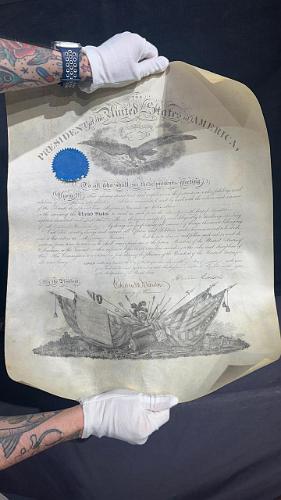
Abraham Lincoln Presidential Document
1864
Vellum in Original Tube and Royal Heraldic Velvet Lined Box
There are no works to discover for this record.