
Winter Thaw
Winter Thaw
Charles Gruppe
American, 1860 - 1940
Oil on Canvas
28 x 36 in. (71.1 x 91.4 cm)
Signed Lower Left
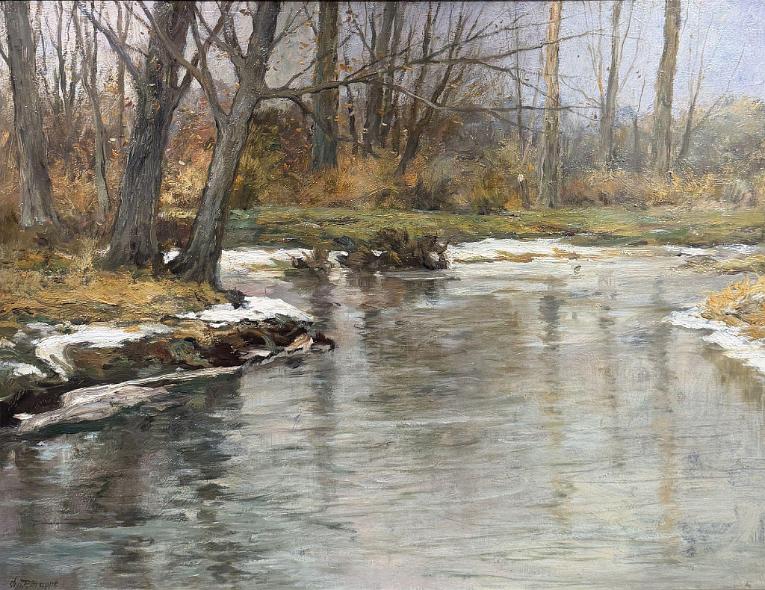
In Winter Thaw, Charles Paul Gruppe captures the quiet transition between seasons, depicting a woodland stream bordered by patches of lingering snow beneath a cool, overcast sky. Bare trees rise along the water’s edge while touches of ochre, russet, and muted green suggest the last remnants of autumn vegetation emerging through the winter landscape. The broad, reflective surface of the stream dominates the composition, its subtle variations of gray, blue, and green lending the scene a remarkable sense of atmosphere and depth.
Gruppe's loose, painterly handling is particularly effective in the foreground, where reflections dissolve into expressive strokes of color. Rather than emphasizing precise topographical detail, the artist concentrates on changing light, water, and atmosphere, transforming an otherwise humble woodland subject into a richly observed study of the natural world.
Charles Paul Gruppe was an American painter best known for his landscapes and marine subjects. Born in Canada in 1860, Gruppe spent much of his early career in Europe and studied at the Royal Academy of Fine Arts in Antwerp. He became associated with the Hague School and was strongly influenced by the Dutch tradition of atmospheric landscape painting.
After returning to the United States, Gruppe established himself as a successful painter and exhibited widely. His work received numerous honors and was shown at major international exhibitions, including the World's Columbian Exposition in Chicago in 1893 and the Louisiana Purchase Exposition in St. Louis in 1904. He was a member of several prominent arts organizations and became especially recognized for his sensitive treatment of landscape, changing weather, and reflected light.
Today, Gruppe's paintings are appreciated for their combination of European academic training and an increasingly impressionistic approach to the American landscape. Winter Thaw, with its restrained palette, vigorous brushwork, and beautifully rendered reflections, is a particularly appealing example of the artist's ability to find poetry in the quieter moments of nature.
In Winter Thaw, Charles Paul Gruppe captures the quiet transition between seasons, depicting a woodland stream bordered by patches of lingering snow beneath a cool, overcast sky. Bare trees rise along the water’s edge while touches of ochre, russet, and muted green suggest the last remnants of autumn vegetation emerging through the winter landscape. The broad, reflective surface of the stream dominates the composition, its subtle variations of gray, blue, and green lending the scene a remarkable sense of atmosphere and depth.
Gruppe's loose, painterly handling is particularly effective in the foreground, where reflections dissolve into expressive strokes of color. Rather than emphasizing precise topographical detail, the artist concentrates on changing light, water, and atmosphere, transforming an otherwise humble woodland subject into a richly observed study of the natural world.
Charles Paul Gruppe was an American painter best known for his landscapes and marine subjects. Born in Canada in 1860, Gruppe spent much of his early career in Europe and studied at the Royal Academy of Fine Arts in Antwerp. He became associated with the Hague School and was strongly influenced by the Dutch tradition of atmospheric landscape painting.
After returning to the United States, Gruppe established himself as a successful painter and exhibited widely. His work received numerous honors and was shown at major international exhibitions, including the World's Columbian Exposition in Chicago in 1893 and the Louisiana Purchase Exposition in St. Louis in 1904. He was a member of several prominent arts organizations and became especially recognized for his sensitive treatment of landscape, changing weather, and reflected light.
Today, Gruppe's paintings are appreciated for their combination of European academic training and an increasingly impressionistic approach to the American landscape. Winter Thaw, with its restrained palette, vigorous brushwork, and beautifully rendered reflections, is a particularly appealing example of the artist's ability to find poetry in the quieter moments of nature.
Categories
There are no works to discover for this record.