
A Mother's Watch
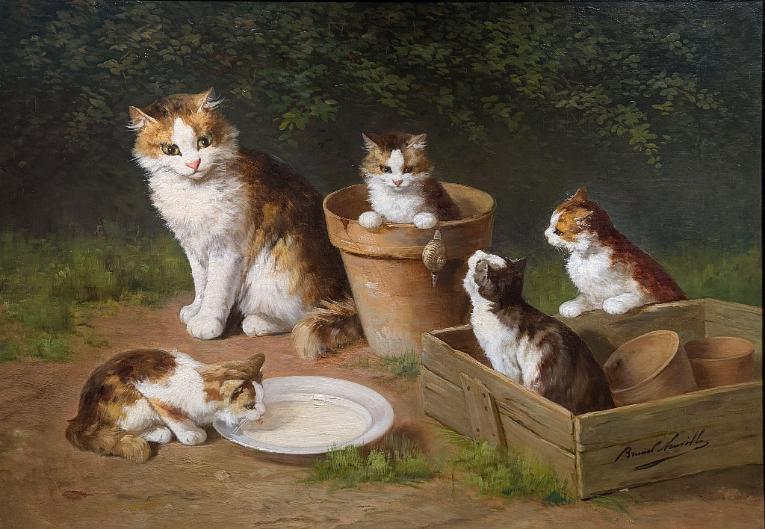



A Mother's Watch
Arthur Alfred Brunel de Neuville
French, 1852 - 1941
Oil on Canvas
25 x 36 1/2 in. (63.5 x 92.7 cm)
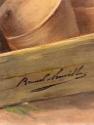
Signed Lower Right
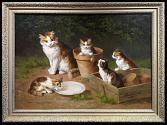
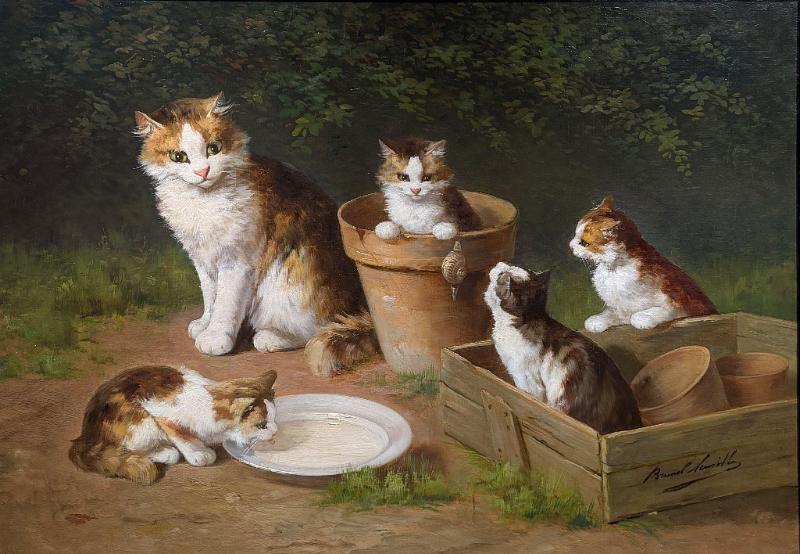
An oil on canvas by Alfred-Arthur Brunel de Neuville, 25 x 36½ inches, depicting the artist's signature subject: a calico mother cat perched watchfully among her four kittens in a sunlit outdoor setting. The kittens tumble and explore around an overturned terracotta pot and a wooden crate, one lapping at a shallow dish while another peers curiously over the crate's edge. Brunel de Neuville's characteristic realist technique is on full display in the soft rendering of fur, the warm earth tones of the garden setting, and the gentle, anecdotal charm with which each kitten is given its own small drama. A large-scale, fully developed example of the feline genre scenes that made the artist one of the most sought-after animal painters of his era.
Alfred-Arthur Brunel de Neuville (1852–1941)
Born Alfred Arthur Brunel on December 2, 1852, in Paris, he was the son of the landscape and still-life painter Léon Brunel, who gave him his early artistic training. He made his Salon debut in 1879 with a still-life of apples and grapes and continued exhibiting at the Paris Salon in the years that followed. Around 1881 he adopted his wife Louise Félicité Neuville's maiden name, signing his work "Brunel de Neuville" from that point on (he is also known to have painted under pseudonyms including Florentin de Neuville and Laurence de Neuville). In 1889 he began exhibiting with the Société des Artistes Français, becoming a full member in 1907.
While still lifes remained part of his output throughout his career, Brunel de Neuville became best known — and, in his lifetime, commercially very successful — for sentimental scenes of cats and kittens at play, a genre he took up around 1880 alongside contemporaries like Henriette Ronner-Knip. Rendered with a realist's eye for texture and light, his feline family groups, tumbling kittens, and quiet domestic vignettes captured the growing 19th-century middle-class taste for charming animal subjects. His work is held today in museums including Béziers, Brest, and Château-Thierry. He died in Paris in 1941 and is buried in Montmartre Cemetery.
An oil on canvas by Alfred-Arthur Brunel de Neuville, 25 x 36½ inches, depicting the artist's signature subject: a calico mother cat perched watchfully among her four kittens in a sunlit outdoor setting. The kittens tumble and explore around an overturned terracotta pot and a wooden crate, one lapping at a shallow dish while another peers curiously over the crate's edge. Brunel de Neuville's characteristic realist technique is on full display in the soft rendering of fur, the warm earth tones of the garden setting, and the gentle, anecdotal charm with which each kitten is given its own small drama. A large-scale, fully developed example of the feline genre scenes that made the artist one of the most sought-after animal painters of his era.
Alfred-Arthur Brunel de Neuville (1852–1941)
Born Alfred Arthur Brunel on December 2, 1852, in Paris, he was the son of the landscape and still-life painter Léon Brunel, who gave him his early artistic training. He made his Salon debut in 1879 with a still-life of apples and grapes and continued exhibiting at the Paris Salon in the years that followed. Around 1881 he adopted his wife Louise Félicité Neuville's maiden name, signing his work "Brunel de Neuville" from that point on (he is also known to have painted under pseudonyms including Florentin de Neuville and Laurence de Neuville). In 1889 he began exhibiting with the Société des Artistes Français, becoming a full member in 1907.
While still lifes remained part of his output throughout his career, Brunel de Neuville became best known — and, in his lifetime, commercially very successful — for sentimental scenes of cats and kittens at play, a genre he took up around 1880 alongside contemporaries like Henriette Ronner-Knip. Rendered with a realist's eye for texture and light, his feline family groups, tumbling kittens, and quiet domestic vignettes captured the growing 19th-century middle-class taste for charming animal subjects. His work is held today in museums including Béziers, Brest, and Château-Thierry. He died in Paris in 1941 and is buried in Montmartre Cemetery.
Categories
There are no works to discover for this record.