Siegfried Gerhard Reinhardt
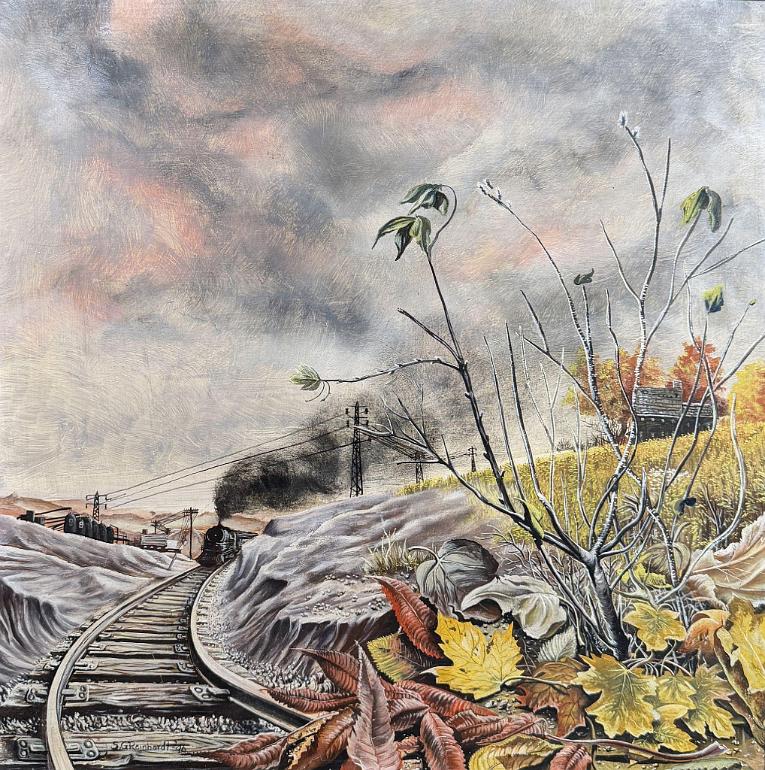
Autumn at the Bend (Hillside in Union, MO)
Siegfried Gerhard Reinhardt
American, 1925 - 1984
1946
Oil on Panel
24 x 24 in. (61.0 x 61.0 cm)
Signed and Dated Lower '46 Lower Left
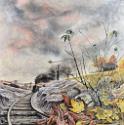
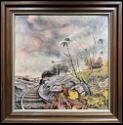
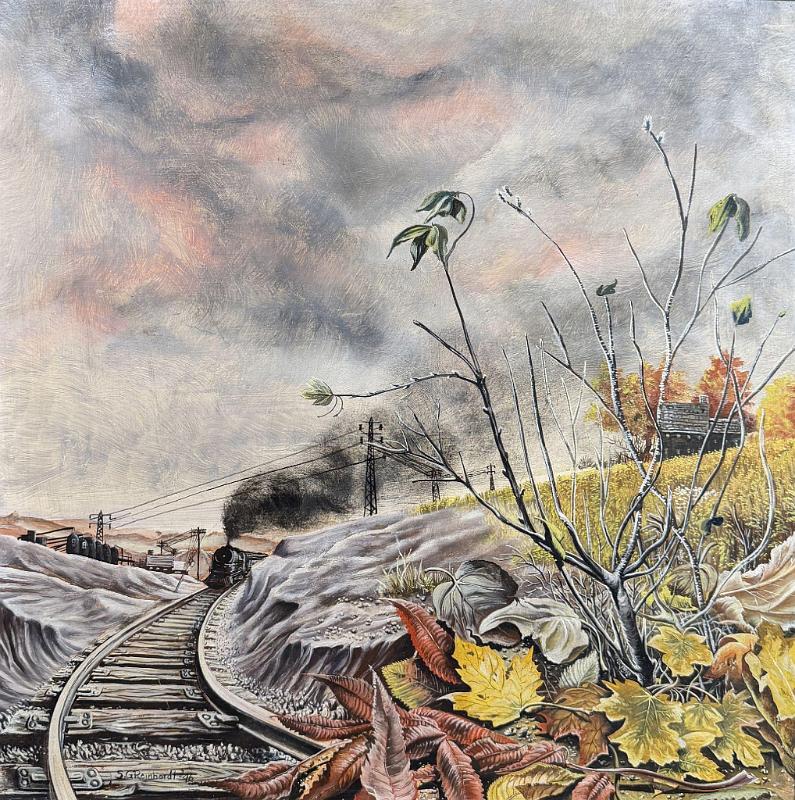
Painted in 1946, not long after Reinhardt's return from naval service, this oil on panel captures a quiet stretch of railroad track curving along a hillside outside Union, Missouri. Dried grasses and turning autumn foliage crowd the foreground in ochre and rust, framing the tracks as they bend away toward a cluster of distant buildings beneath a heavy, overcast sky. The square 24 x 24 inch format and close, textured brushwork give the scene an intimate, almost diaristic quality — an early landscape study from an artist who would soon turn toward the more surreal, figure-driven imagery for which he later became known. Signed and dated lower left, '46.
Siegfried Gerhard Reinhardt (1925–1984)
Born in Eydkuhnen, Germany, in 1925, Siegfried Reinhardt emigrated with his family to the St. Louis area in 1928 and was naturalized as a U.S. citizen in 1936. Largely self-taught and drawn to painting from childhood, he enlisted in the U.S. Navy in 1944, serving as an illustrator for Stars and Stripes before returning to St. Louis after the war. In 1950 he earned a B.A. in English Literature from Washington University in St. Louis, where he went on to teach studio art from 1955 to 1970; he also held artist-in-residence posts at Southern Illinois University and St. Louis Community College–Meramec.
Reinhardt's mature style — a blend of sharp realism and dreamlike invention sometimes described as "superrealism" — brought him national attention early: Life magazine named him one of nineteen important young American artists in 1950 and profiled him again in 1952, and Time featured him in 1960. A longtime member of the St. Louis Artists Guild, he spent decades designing stained glass windows with St. Louis's Emil Frei Inc. and hosted a televised painting series, Man of Sorrows, on KETC in the late 1950s. His best-known public work is the 142-foot mural depicting the history of aviation at St. Louis's Lambert International Airport. He died in St. Louis in 1984.
Painted in 1946, not long after Reinhardt's return from naval service, this oil on panel captures a quiet stretch of railroad track curving along a hillside outside Union, Missouri. Dried grasses and turning autumn foliage crowd the foreground in ochre and rust, framing the tracks as they bend away toward a cluster of distant buildings beneath a heavy, overcast sky. The square 24 x 24 inch format and close, textured brushwork give the scene an intimate, almost diaristic quality — an early landscape study from an artist who would soon turn toward the more surreal, figure-driven imagery for which he later became known. Signed and dated lower left, '46.
Siegfried Gerhard Reinhardt (1925–1984)
Born in Eydkuhnen, Germany, in 1925, Siegfried Reinhardt emigrated with his family to the St. Louis area in 1928 and was naturalized as a U.S. citizen in 1936. Largely self-taught and drawn to painting from childhood, he enlisted in the U.S. Navy in 1944, serving as an illustrator for Stars and Stripes before returning to St. Louis after the war. In 1950 he earned a B.A. in English Literature from Washington University in St. Louis, where he went on to teach studio art from 1955 to 1970; he also held artist-in-residence posts at Southern Illinois University and St. Louis Community College–Meramec.
Reinhardt's mature style — a blend of sharp realism and dreamlike invention sometimes described as "superrealism" — brought him national attention early: Life magazine named him one of nineteen important young American artists in 1950 and profiled him again in 1952, and Time featured him in 1960. A longtime member of the St. Louis Artists Guild, he spent decades designing stained glass windows with St. Louis's Emil Frei Inc. and hosted a televised painting series, Man of Sorrows, on KETC in the late 1950s. His best-known public work is the 142-foot mural depicting the history of aviation at St. Louis's Lambert International Airport. He died in St. Louis in 1984.