
George Inness Jr
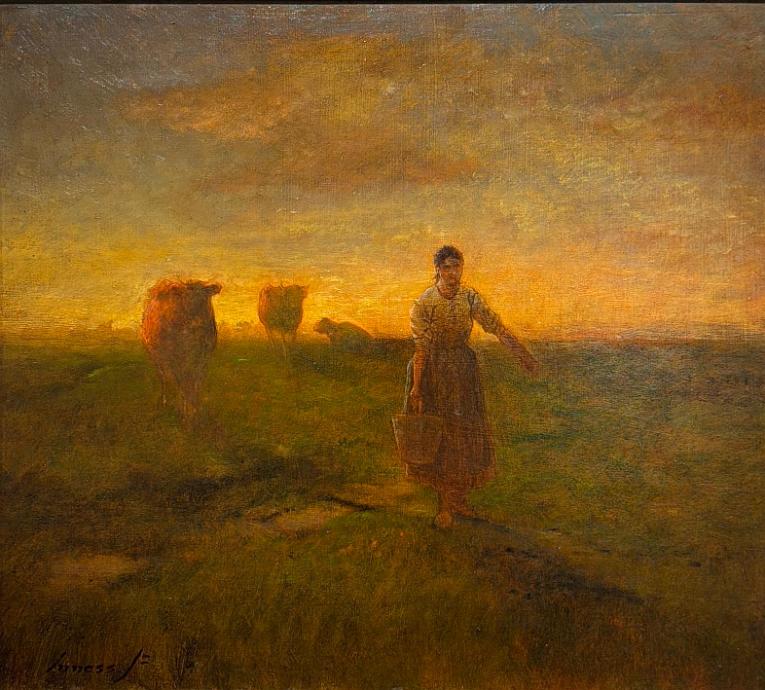
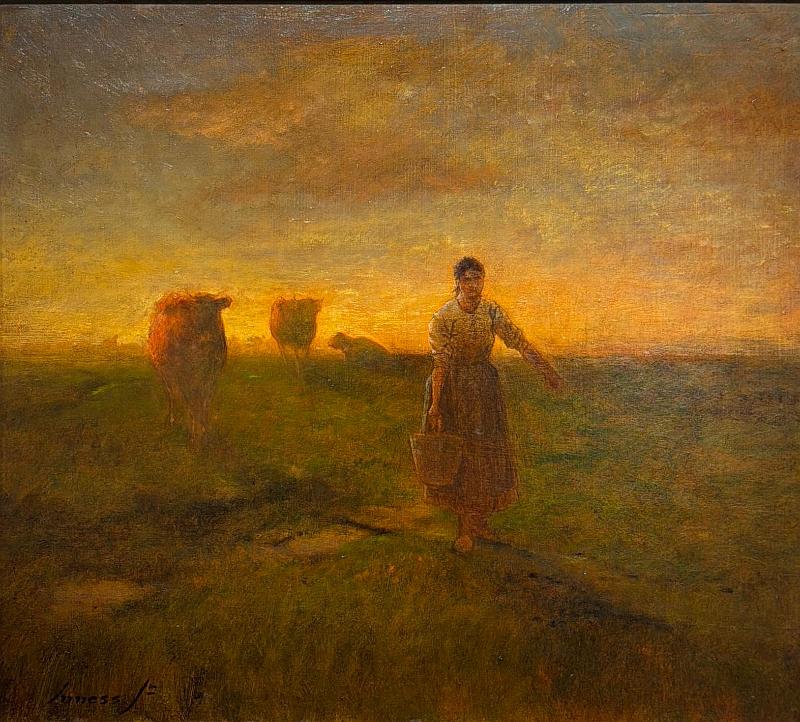
George Inness Jr
American, 1854 - 1926
He began his art studies in Rome with his father, landscape painter George Inness Sr., and then continued his studies with Leon Bonnat in Paris. In 1875, the Inness family returned to America, and from 1878, he and his father shared a studio in New York City. The young Inness earned a good reputation, underscored by his beginning in 1887 to exhibit at the National Academy of Design and his election to the Salmagundi Club.
However, Inness Jr., as he signed his work, determined to distance himself from his father's strong personality, tonalist style, and landscape subjects. He re-directed himself to depictions of figures and animals. During the 1880s, he went to California as an illustrator of big game hunts for New York magazine publishers of Scribners and Century. It is possible at this time that he also did painting in Arizona, as a Grand Canyon painting by George Inness, Jr. as well as others sponsored by the Santa Fe Railway, was exhibited in 1912 in several institutions including the Cincinnati Art Museum. As a result of participation in this traveling exhibition, Inness and the other artists were organizing members of the Society of Painters of the Far West, also known as the Society of Men Who Paint the Far West.
His father died in 1894, and George Jr. went to Paris, where he had a studio from 1895-99. From death, his father continued to influence him, and he asserted that George Inness Sr. appeared to him in a vision with comments that his future direction should be religious subjects. From 1918 to 1922, the son painted religious allegories on themes of "promise, realization and fulfillment". (Zellman 749) Some of these paintings are held in the Good Shepherd Church in Tarpon, Florida where Inness had a winter home.
He died in Cragsmoor, New York in 1926.
Sources:
Edan Hughes, Artists in California, 1786-1940
Michael David Zellman, 300 Years of American Art
William Gerdts, Art Across America, Volume III
There are no works to discover for this record.