
Moonlight Ballet

Moonlight Ballet
Ernst Oppler
German, 1867 - 1929
Oil on Canvas
18 x 26 in. (45.7 x 66.0 cm)
Signed Upper Right
Ernst Oppler (1867–1929) was a German Impressionist painter and etcher born in Hanover who studied at the Munich Academy and later moved to London to study the work of James Abbott McNeill Whistler. After practicing plein air painting in the Netherlands, Oppler relocated to Berlin in 1904 at the invitation of Max Liebermann, where he became a prominent member of the Berlin Secession.
Though trained as a portraitist and landscape painter, Oppler's fascination with dance began around 1909 after seeing acclaimed Russian ballerina Anna Pavlova perform. His obsession with capturing dancers in motion became so great that he developed a lighted pen in order to sketch in darkened theaters during performances. In the early 1900s, Oppler became one of the most renowned artistic chroniclers of the history of German ballet, using his power of observation to depict the legendary Ballet Russes dancers such as Vaslav Nijinsky and Anna Pavlova.
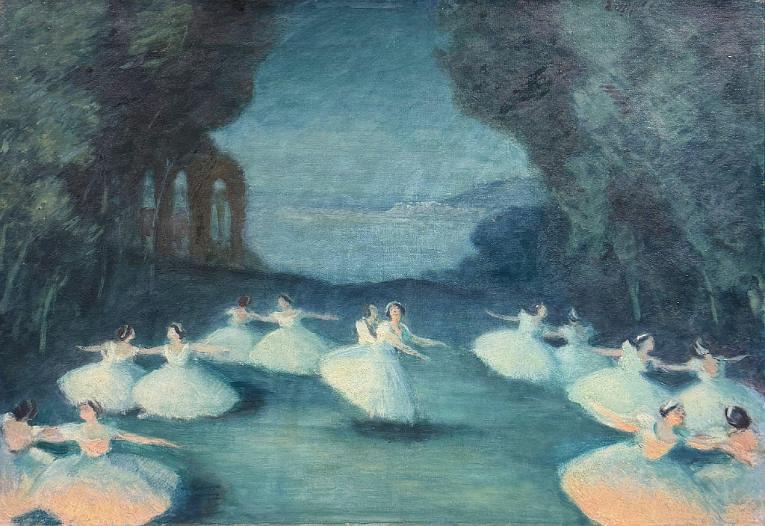
Moonlight Ballet exemplifies Oppler's distinctive approach to the subject. The nocturnal setting—with its silvery light and atmospheric mystery—transforms the ballet stage into an enchanted realm where dancers seem suspended between earthly performance and dreamlike reverie. Unlike other artists, Oppler did not seek to portray "dance" as a concept, but rather the distinct personality of each dancer while on stage. The composition captures the ethereal quality of movement through luminous brushwork and the interplay of shadow and light that defines both the ballet stage and the mysterious nocturne.
Oppler's works are held in major international collections including the National Gallery Berlin, Neue Pinakothek Munich, the Metropolitan Museum of Art, the San Francisco Museum of Modern Art, and the Harvard Art Museums, attesting to his enduring significance as a chronicler of one of modernity's most transformative artistic innovations.
Ernst Oppler (1867–1929) was a German Impressionist painter and etcher born in Hanover who studied at the Munich Academy and later moved to London to study the work of James Abbott McNeill Whistler. After practicing plein air painting in the Netherlands, Oppler relocated to Berlin in 1904 at the invitation of Max Liebermann, where he became a prominent member of the Berlin Secession.
Though trained as a portraitist and landscape painter, Oppler's fascination with dance began around 1909 after seeing acclaimed Russian ballerina Anna Pavlova perform. His obsession with capturing dancers in motion became so great that he developed a lighted pen in order to sketch in darkened theaters during performances. In the early 1900s, Oppler became one of the most renowned artistic chroniclers of the history of German ballet, using his power of observation to depict the legendary Ballet Russes dancers such as Vaslav Nijinsky and Anna Pavlova.
Moonlight Ballet exemplifies Oppler's distinctive approach to the subject. The nocturnal setting—with its silvery light and atmospheric mystery—transforms the ballet stage into an enchanted realm where dancers seem suspended between earthly performance and dreamlike reverie. Unlike other artists, Oppler did not seek to portray "dance" as a concept, but rather the distinct personality of each dancer while on stage. The composition captures the ethereal quality of movement through luminous brushwork and the interplay of shadow and light that defines both the ballet stage and the mysterious nocturne.
Oppler's works are held in major international collections including the National Gallery Berlin, Neue Pinakothek Munich, the Metropolitan Museum of Art, the San Francisco Museum of Modern Art, and the Harvard Art Museums, attesting to his enduring significance as a chronicler of one of modernity's most transformative artistic innovations.
Categories
There are no works to discover for this record.