
Grant Wood's First Lithograph
Grant Wood's First Lithograph
2022-01-06
Grant Wood's First Lithograph
January 6, 2022
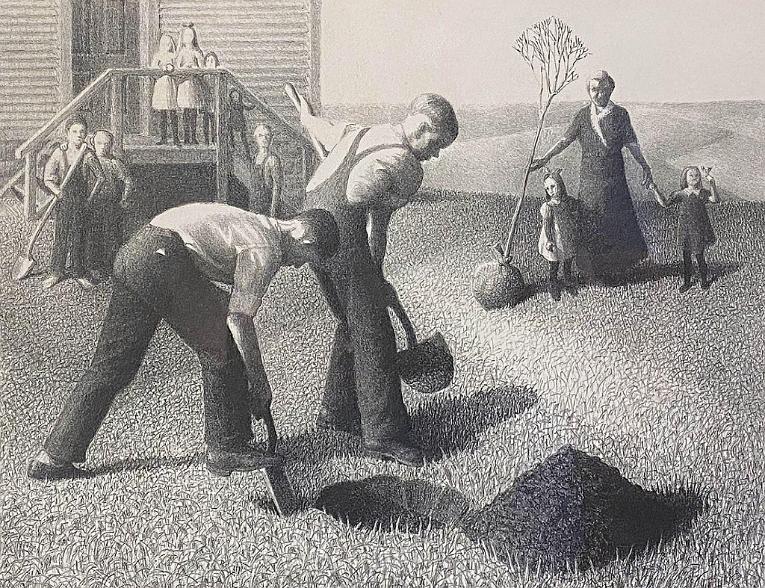
Tree Planting Group is the first lithograph ever created by Wood.
Distributed by the Association of American Artists, the work depicts an incredibly cheerful subject matter. Wood illustrates a family celebrating Arbor Day. Two young men in the foreground dig a hole for the tree. A woman holds the sapling, with wrapped bulb ready to be plated, as she is flanked by two excited young children. Several figures observe from the steps of a small house.
Tree Planting Group can be found in the collection of major institutions such as:
The Whitney Museum of American Art in New York, New York
Amon Carter Museum of Art in Fort Worth, Texas
The Art Institute of Chicago, in Chicago, Illinois
Museum of Fine Arts, in Boston, Massachusetts
The Metropolitan Museum of Art, in New York, New York


Grant Wood (American, 1881-1942)
Tree Planting Group, 1937
Edition of 250
Lithograph
8 1/2 x 11 inches
Hand Signed and Dated Lower Right in Pencil
Available for Purchase


Grant Wood was an American artist and leading figure of the Regionalist movement. Known for his smoothly rendered paintings of the American Midwest, his iconic work American Gothic (1930), has become one of the most recognizable paintings of the 20th century. The slightly unsettling work depicts a male and female farmer standing side-by-side before their Gothic Revival house. “Technique does not constitute art. Nor is it a vague, fuzzy romantic quality known as ‘beauty,’ remote from the realities of everyday life,” he once explained. “It is the depth and intensity of an artist’s experience that are the first importance in art.” Born on February 13, 1891 in Anamosa, IA, Wood studied arts and craft at the Handicraft Guild School in Minneapolis, and went on to attend the School of the Art Institute of Chicago. In 1923, he traveled to Europe to study at the Académie Julian in Paris and produced several views of the city in an impressionistic style. During his time abroad, he became increasingly influenced by the delineated style of early German and Flemish artists, such as Jan Van Eyck. Upon returning to the United States, Wood melded Northern Renaissance technique with the newfound embrasure of his Midwestern heritage. Like other American Regionalists Thomas Hart Benton and John Steuart Curry, Wood would go on to paint cornfields, farmers, and scenes from American history. The artist died on February 12, 1942 in Iowa City, IA. Today, his works can be found in the collections of the Art Institute of Chicago, The Metropolitan Museum of Art in New York, the National Gallery of Art in Washington D.C., and the Los Angeles County Museum of Art, among others.
January 6, 2022
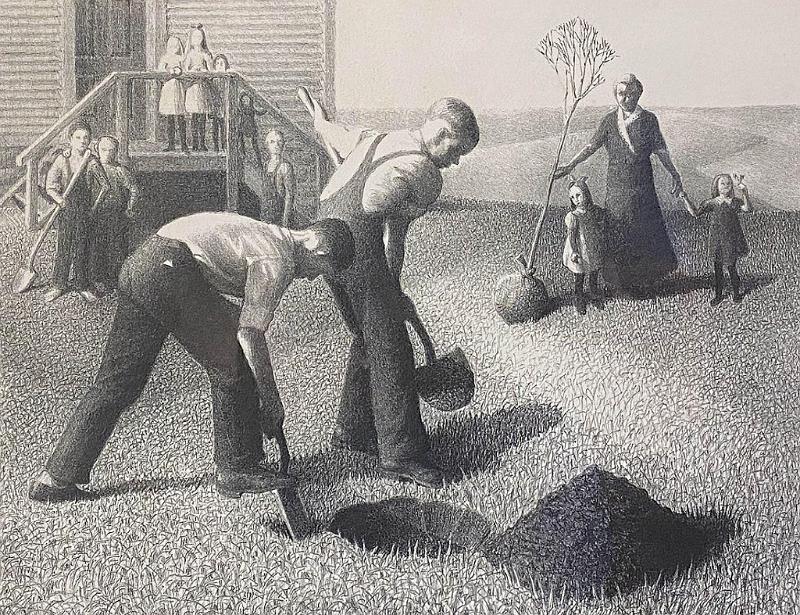
Tree Planting Group is the first lithograph ever created by Wood.
Distributed by the Association of American Artists, the work depicts an incredibly cheerful subject matter. Wood illustrates a family celebrating Arbor Day. Two young men in the foreground dig a hole for the tree. A woman holds the sapling, with wrapped bulb ready to be plated, as she is flanked by two excited young children. Several figures observe from the steps of a small house.
Tree Planting Group can be found in the collection of major institutions such as:
The Whitney Museum of American Art in New York, New York
Amon Carter Museum of Art in Fort Worth, Texas
The Art Institute of Chicago, in Chicago, Illinois
Museum of Fine Arts, in Boston, Massachusetts
The Metropolitan Museum of Art, in New York, New York
Grant Wood (American, 1881-1942)
Tree Planting Group, 1937
Edition of 250
Lithograph
8 1/2 x 11 inches
Hand Signed and Dated Lower Right in Pencil
Available for Purchase
Grant Wood was an American artist and leading figure of the Regionalist movement. Known for his smoothly rendered paintings of the American Midwest, his iconic work American Gothic (1930), has become one of the most recognizable paintings of the 20th century. The slightly unsettling work depicts a male and female farmer standing side-by-side before their Gothic Revival house. “Technique does not constitute art. Nor is it a vague, fuzzy romantic quality known as ‘beauty,’ remote from the realities of everyday life,” he once explained. “It is the depth and intensity of an artist’s experience that are the first importance in art.” Born on February 13, 1891 in Anamosa, IA, Wood studied arts and craft at the Handicraft Guild School in Minneapolis, and went on to attend the School of the Art Institute of Chicago. In 1923, he traveled to Europe to study at the Académie Julian in Paris and produced several views of the city in an impressionistic style. During his time abroad, he became increasingly influenced by the delineated style of early German and Flemish artists, such as Jan Van Eyck. Upon returning to the United States, Wood melded Northern Renaissance technique with the newfound embrasure of his Midwestern heritage. Like other American Regionalists Thomas Hart Benton and John Steuart Curry, Wood would go on to paint cornfields, farmers, and scenes from American history. The artist died on February 12, 1942 in Iowa City, IA. Today, his works can be found in the collections of the Art Institute of Chicago, The Metropolitan Museum of Art in New York, the National Gallery of Art in Washington D.C., and the Los Angeles County Museum of Art, among others.

2022-01-01

2024-05-07

2022-04-18
2024-04-24
2024-04-28
2022-01-01