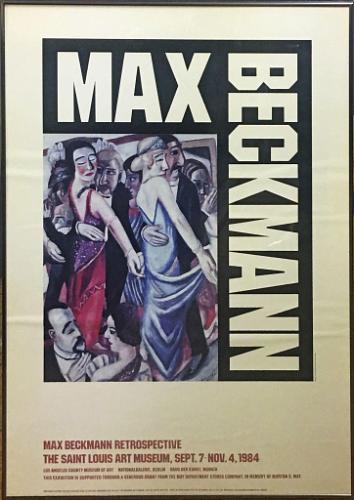
Sleeping Workmen
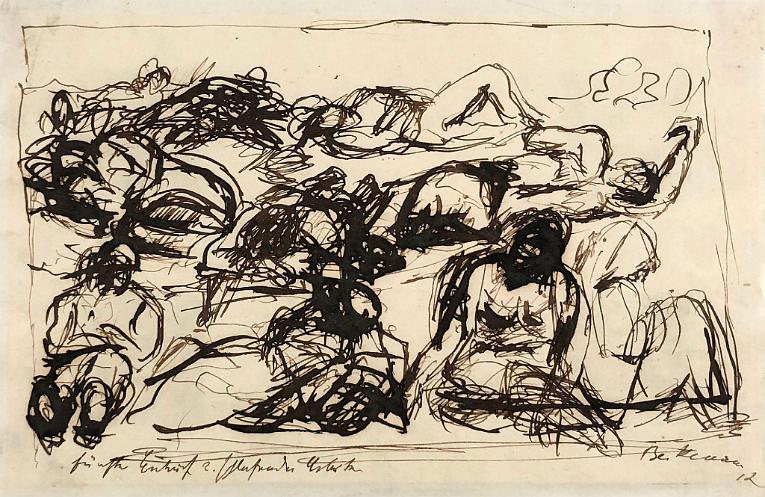
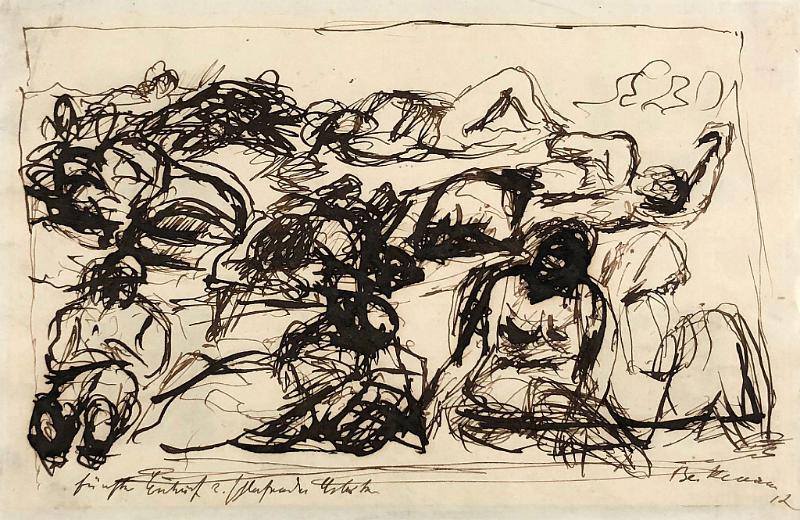
Sleeping Workmen
Max Beckmann
German-American, 1884 - 1950
1912
Pen and Ink
5 1/4 x 8 1/2 in. (13.3 x 21.6 cm)
Signed and Dated Lower Right
Inscribed Lower Left
Max Beckmann (1884–1950) was a German painter, draftsman, printmaker, sculptor, and writer who is widely regarded as one of the major figures of the Expressionist and New Objectivity movements, though he rejected both labels. Born in Leipzig, Beckmann studied the works of Paul Cézanne, Vincent van Gogh, and Peter Paul Rubens as a young man, and served as a medic during World War I, an experience whose trauma profoundly shaped his artistic vision.
"Sleeping Workmen" belongs to a pivotal moment in Beckmann's artistic development—1912, the same year he began work on his monumental painting *The Sinking of the Titanic* (1912–1913), now in the Saint Louis Art Museum collection. Both works reveal Beckmann's intense preoccupation with human vulnerability in the face of catastrophe and social indifference. Where *The Sinking of the Titanic* depicts the chaos and moral collapse of a disaster at sea, *Sleeping Workmen* captures the quiet, everyday exhaustion of laboring men—rendered with nervous, gestural pen strokes that convey both physical fatigue and existential unease. The drawing's expressive urgency suggests that ordinary hardship and historical trauma are equally worthy of the artist's unflinching attention.
After being denounced as a "degenerate artist" by Hitler, Beckmann fled to Amsterdam, then moved to St. Louis in 1947 after securing a teaching post at Washington University. There he met retailer and collector Morton D. May, who became his patron and eventually amassed the largest Beckmann collection in the world, which he bequeathed to the Saint Louis Art Museum. The St. Louis Art Museum now holds the world's most comprehensive collection of Beckmann's paintings—the largest of its kind anywhere.
Inscribed Lower Left
Max Beckmann (1884–1950) was a German painter, draftsman, printmaker, sculptor, and writer who is widely regarded as one of the major figures of the Expressionist and New Objectivity movements, though he rejected both labels. Born in Leipzig, Beckmann studied the works of Paul Cézanne, Vincent van Gogh, and Peter Paul Rubens as a young man, and served as a medic during World War I, an experience whose trauma profoundly shaped his artistic vision.
"Sleeping Workmen" belongs to a pivotal moment in Beckmann's artistic development—1912, the same year he began work on his monumental painting *The Sinking of the Titanic* (1912–1913), now in the Saint Louis Art Museum collection. Both works reveal Beckmann's intense preoccupation with human vulnerability in the face of catastrophe and social indifference. Where *The Sinking of the Titanic* depicts the chaos and moral collapse of a disaster at sea, *Sleeping Workmen* captures the quiet, everyday exhaustion of laboring men—rendered with nervous, gestural pen strokes that convey both physical fatigue and existential unease. The drawing's expressive urgency suggests that ordinary hardship and historical trauma are equally worthy of the artist's unflinching attention.
After being denounced as a "degenerate artist" by Hitler, Beckmann fled to Amsterdam, then moved to St. Louis in 1947 after securing a teaching post at Washington University. There he met retailer and collector Morton D. May, who became his patron and eventually amassed the largest Beckmann collection in the world, which he bequeathed to the Saint Louis Art Museum. The St. Louis Art Museum now holds the world's most comprehensive collection of Beckmann's paintings—the largest of its kind anywhere.