
Josef Israels
Josef Israels
Dutch, 1824 - 1911
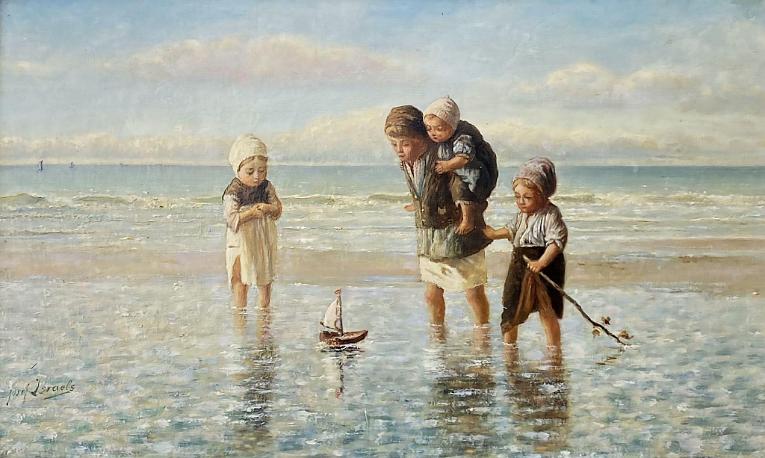
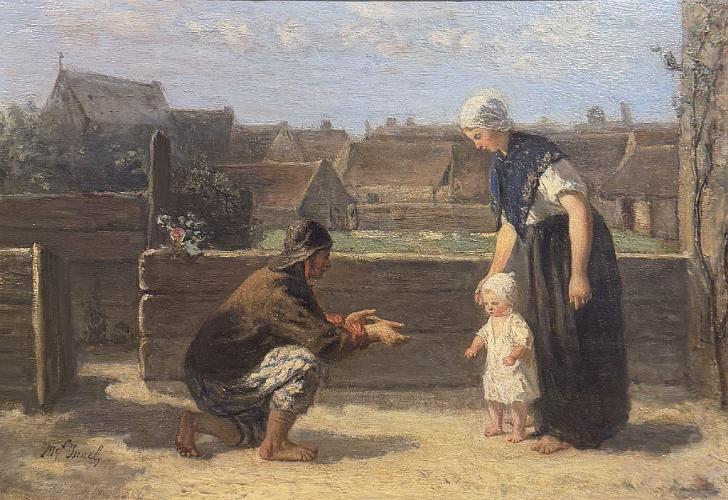
It was however, the humble fisher-folk of Zandboort, a remote village on the northern coast of Holland, who determined the direction of his art. There, in 1855, he observed their daily routine, their natural, simple existence, with its sorrows and terrors and little joys, all unspoiled by the requirements of society. His eyes were opened to the beauty of real life and he came to see its drama was well worth depicting.
Of his style and the influence of Rembrandt the artist stated: "I began to realize that true art does not consist in smoothly finished drawing and scrupulously exact coloration. I perceived that I had to occupy myself much more with the correct appreciation of light and shade, with the attitudes and movements of beings and thing… In Rembrandt alone did I find that breadth and freedom of execution which was lacking in all the others."
In 1870 Israels became one of a number of artists taking up residence at The Hague, which, like Paris, became a center to which painters flocked. He was to become the acknowledged leader of The Hague School, which took the art of Holland to its highest point since the 17th century.
The artist won many honors; the Cross of the French Legion of Honor, a Chevalier of the Order of Leopold and even a medal at Philadelphia, but what he treasured most was the affection and admiration of his fellow countrymen who acknowledged him as a true interpreter of the Dutch character and spirit.
Biography excerpted from the unpublished catalog by Edward P. Bentley for the Haussner Restaurant in Baltimore, Maryland, titled: Haussner's, The Children.
There are no works to discover for this record.